



Diversity in the APS workforce
Under Section 41 of the Public Service Act 1999, the Australian Public Service Commissioner has a responsibility to foster an APS workforce that reflects the diversity of the Australian community. The Employment Principles in Section 10 of the Act require the APS to recognise the diversity of the Australian community and foster diversity in the workplace.
The APS is committed to being inclusive, a place where all Australians are welcome and belong. It is creating respectful and safe workplaces, and building a diverse workforce. A public service that reflects the experience, insights and backgrounds of the wider Australian community provides better informed policy and services. Diversity helps the APS to do its job better and to be a better workplace.
There has been good progress with diversity and inclusion in 2024 ꟷ 25:
- for the first time, more than 100 First Nations leaders are in Senior Executive Service roles (111 leaders at 30 June 2025)
- CALD Inclusive Leadership Guidance has been published to help SES leaders build culturally inclusive APS workplaces
- the Workplace Gender Equality Agency provided the first-ever publication of gender pay gaps across 120 Commonwealth public sector employers
- the SES Disability Network doubled its membership, raised its profile, and engaged more SES staff with lived experience
- Services Australia and the Australian Taxation Office have reached Platinum status on the Australian Workplace Equality Index, a national benchmark on LGBTQA+ workplace inclusion
- Social Services released Australia’s first National Autism Strategy and First Action Plan 2025 ꟷ 26.
First Nations employment
At 30 June 2025, 111 First Nations leaders were serving in Senior Executive Service positions across the APS. This milestone was achieved through the successful implementation of the SES100 program. SES100 is a flagship program under the Boosting First Nations Employment in the APS initiative that aims for First Nations employees to make up 5% of the APS workforce by 2030.
The SES100 program has become a leading example of how co-design, cultural safety and system leadership can drive inclusion at the most senior levels. Designed and delivered by the First Nations Unit, the program has embedded culturally safe recruitment processes for SES Band 1 and Band 2 roles. The Yawarra (Wiradjuri for “To take care of”) program provides structured support for SES100 appointees during their first 12 months in role, ensuring their success and strengthening cultural capability in the APS.
The impact of SES100 is reaching beyond the APS. The program has drawn strong attention from the private and state government sectors that are now seeking to adapt the model to increase representation of First Nations leaders in their own senior executive ranks. This cross-sector interest underscores the strength of the SES100 design and its potential to reshape leadership pipelines nationally.
Alongside increasing First Nations SES representation, the broader initiative is building a sustainable pipeline of First Nations talent at the executive level. The Bulabul (Wiradjuri for “Together”) program is supporting First Nations executive level employees, by preparing them for senior roles and embedding cultural safety throughout their journey. Together, the First Nations designed and led Bulabul and Yawarra programs are reinforcing cultural accountability and creating lasting capability across the system.
CALD employment
The Australian Public Service Commission is developing and progressing whole-of-government initiatives to deliver on the objectives of the Culturally and Linguistically Diverse Employment Strategy and Action Plan.
At 30 June 2025, 26.8% of APS employees reported their first language was not exclusively English, up from 25.9% at 30 June 2024 (APSED).
The APSC has delivered a CALD Capability Uplift package of resources and regular coaching sessions to lead agencies to support the development of CALD action plans to improve multicultural awareness, cultural safety and recruitment processes. Courses, including MOSAIC Parts 1 and 2, are available to support agencies with a strong foundation of multicultural learning.
Released in December 2024, the CALD Compact and Inclusive Leadership Guidance helps SES leaders build culturally inclusive APS workplaces and emphasises the importance of cultural capability in leadership roles. The statement outlines legislative responsibilities and empowers leaders to create workplaces that are more inclusive by modelling curiosity and psychological safety.
The Australian Human Rights Commission released a National Anti-Racism Framework in November 2024. It proposes a roadmap for governments, business and community organisations to address all forms of racism in Australia, using a whole of society approach.
Gender equality
In May 2025, the Workforce Gender Equality Agency released the Commonwealth Public Sector Gender Equality Scorecard Key Results from 2023. This was the first time WGEA published gender pay gaps for 120 Commonwealth public sector employers.
The WGEA Gender Equality Scorecard shows that Commonwealth public sector employers have an average total remuneration gap of 6.4%, compared to 21.1% in the private sector (excluding CEOs and Heads of Business). It notes that flexible work contributes to the high rates of full-time work among women in the public sector (76%) compared to the private sector (just 43%).
In December 2024, the APS achieved its lowest recorded gender pay gap of 4.4%, based on annualised base salaries. The national gender pay gap was 11.5% in August 2024, according to the Australian Bureau of Statistics. The APS continues to see a significant reduction in the gender pay gap over time, reducing from 10.2% in 2011 to 4.4% in 2024.
The distribution of women across classification levels significantly influences the APS gender pay gap. A higher concentration of women in lower classifications (APS3-5) contributes to the overall gap, despite near pay parity within individual classification levels.
There has been a continued increase in representation of women at higher classifications (Executive Level 1 and above) since 2018, along with a slight decrease in women at lower classifications. These trends underscore the importance of ongoing efforts to promote gender balance across all classification levels to reduce the gender pay gap in the APS.
The APS remains committed to closing the gender pay gap. This is in line with national priorities to progress economic equality and security, articulated in Working for Women: A Strategy for Gender Equality.
Employees with disability
At 30 June 2025, 5.8% of APS employees reported having disability, up from 5.7% at 30 June 2024 (APSED).
The Royal Commission into Violence, Abuse, Neglect and Exploitation of People with Disability Final Report, released in September 2023, highlighted the need for greater inclusion of people with disability.
The APSC set up the Disability Royal Commission Discovery Project in 2024 to consider the 5 recommendations aimed at improving employment for people with disability in the APS. The project team includes seconded staff from across the public service, including staff with lived experience of disability. Seconded staff brought a rich understanding of disability employment within the APS to inform the project. Results from this work will contribute to the Australian Government’s response to the 5 recommendations for the APS from the Disability Royal Commission.
The APS SES Disability Network has raised its profile and boosted its influence in 2025, doubling its membership and engaging more SES staff who identify as people with disability. Its growing profile is due in part to promotions run by Network Chairs in collaboration with the APSC.
In December 2024, newly appointed Disability Champion and Department of Social Services Secretary, Michael Lye, endorsed the Network’s successful bid to join the SES Disability Champions Network. This strengthens collaboration between SES staff with lived experience and agency disability champions. The partnership will help the Network better advocate for and support disability employment initiatives across the APS.
National Autism Strategy
In January 2025, Social Services released Australia’s first National Autism Strategy 2025 ꟷ 31. It is designed to improve the quality of life for Autistic people in ways that are meaningful to them.
The Strategy was released with funding of $42.3 million for the First Action Plan 2025 ꟷ 26. Actions planned over the coming years include:
- identifying ways to improve Australian Government services, supports, information and the safety and welfare of Autistic people
- developing new awareness and educational initiatives that enhance community understanding, awareness and acceptance of autism and Autistic people
- delivering a peer support program that will create safe and inclusive spaces where participants can connect, share experiences and build practical skills for navigating life as Autistic individuals
- evaluating the effectiveness of existing autism-specific employment programs to improve employment supports and opportunities for Autistic people
- establishing a governance framework that ensures the autism community has sustained involvement in the implementation and monitoring of the Strategy.
The First Action Plan includes 3 actions for the APS workforce. These focus on improving employment opportunities, supporting Autistic employees in the workplace, and helping employers hire and retain Autistic staff.
The Strategy team shared the national consultation approach at the 2024 United Nations Conference of State Parties in New York, and with the United States Interagency Autism Coordinating Committee in Washington. It is a strong example of working in partnership to co-design inclusive community-led policy development.
Neurodiversity Community of Practice
In the 2025 APS Employee Census, 10.8% of respondents considered themselves to be neurodivergent and another 11.2% considered that they may be neurodivergent. This is an increase from 2024, where 8.8% of respondents considered themselves to be neurodivergent and another 9.3% considered that they may be neurodivergent.
APS employees contributed to consultations on Australia’s First National Autism Strategy through the Neurodiversity Community of Practice. Their consolidated feedback helped shape recommendations in the First Action Plan.
Collaboration with APS agencies continued in early 2025, with input provided on Finance’s Property Accessibility Assessment Tool and updates to the Australian Government Style Manual content on neurodiversity.
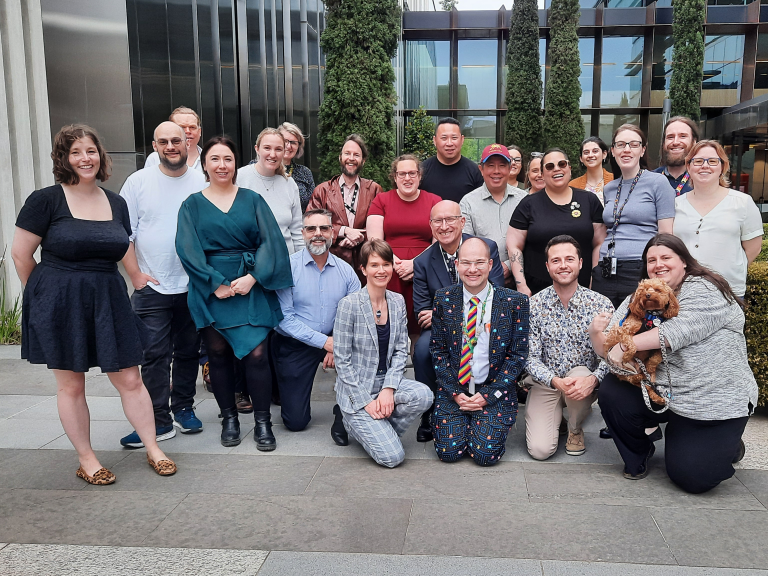
Attendees at the Public Sector Neurodiversity Community of Practice’s end of year social gathering in November 2024.
Image: Neurodiversity Community of Practice.
In November 2024, Minister for the Public Service, Senator the Hon Katy Gallagher, presented the inaugural Public Sector Neurodiversity Excellence Awards. These awards recognise and celebrate neurodiversity inclusion initiatives across the public sector.
The Neurodiversity Community of Practice hosts APS-wide events to strengthen awareness, capability and connections. By 2025, membership had grown to more than 1,500 people across more than 190 federal, state and territory agencies. The Community of Practice also shares resources to support employees, including a monthly newsletter launched in October 2024.
LGBTIQA+ community
In the 2025 APS Employee Census, 9.5% of respondents identified as LGBTIQA+, up from 9.2% of respondents in 2024.
In 2025, Services Australia and the Australian Taxation Office received recognition for their LGBTIQA+ workplace policies after reaching Platinum Status on the Australian Workplace Equality Index, a national benchmark on LGBTQA+ workplace inclusion. At Services Australia, this milestone is part of a 10-year journey to develop a safe, inclusive workplace for people of all LGBTIQ+ communities.
The ATO’s recognition is for the partnerships between the ATO’s ATOMIC (ATO Making Inclusion Count) network for LGBTQ+ employees and allies, SES LGBTQ+ Champions and the Inclusion and Diversity team in ATO People, all supported by senior executives within the agency.
The Pride Network at the Department of Climate Change, Energy, the Environment and Water launched the ALIVE Allyship Guide to mark IDAHOBIT. The Network’s Co-Chairs collaborated with LGBTIQA+ staff and allies to develop the guide, which shares practical actions and lived experiences to help departmental staff Advocate, Listen, be Inclusive, stay Visible, and Educate themselves.
See also in this report
APS Workforce – APS at a glance
Appendix 2 – State of the Service additional data
Find out more
Australian Public Service Commission (2025) First Nations employment, APSC website, accessed 10 September 2025.
Australian Public Service Commission (2024) APS Culturally and Linguistically Diverse Employment Strategy and Action Plan, APSC website, accessed 9 September 2025.
Workplace Gender Equality Agency (2025) WGEA Commonwealth Public Sector Gender Equality Scorecard |WGEA, WGEA website, accessed 9 September 2025.
Royal Commission (2023) Royal Commission into Violence, Abuse, Neglect and Exploitation of People with Disability, Royal Commission website, accessed 10 September 2025.
Services Australia (2025) Employment support for LGBTQIA+ staff, Services Australia website, accessed 10 September 2025.
Australian Taxation Office (2025) Focus on inclusion and diversity, ATO website, accessed 10 September 2025.
Department of Social Services (2025) National Autism Strategy, DSS website, accessed 10 September 2025.
Australian Public Service Commission (2024) Public Sector Neurodiversity Community of Practice, APSC website, accessed 10 September 2025.