



Supporting first-time mothers in regional and remote communities

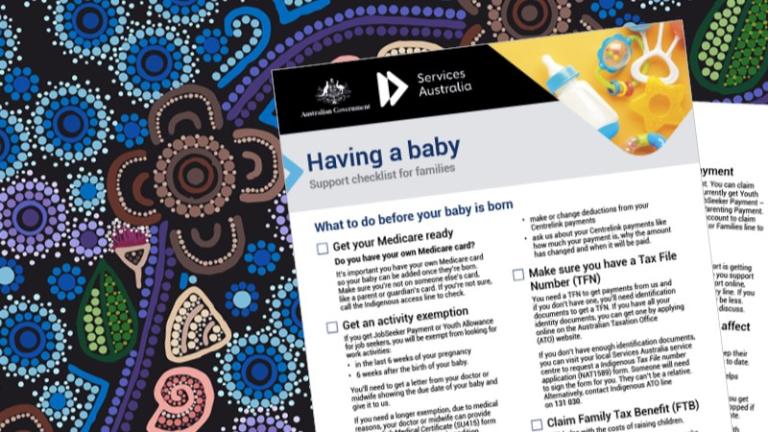
Having a baby checklist developed to support families in regional and remote communities.
Image: Services Australia
Having a baby can be daunting for any first-time mother. Young Indigenous women living in regional and remote communities face additional challenges that make it harder to access necessary government services when they most need them.
An Indigenous Service Officer from a Services Australia office in Western Australia noted that many first-time mothers did not have important and clear information on what they needed to do before and after their baby was born. For example, they lacked key identity documents, a Tax File Number and other details. This can delay access to essential payments and services such as Family Tax Benefit, Parenting Payment, Child Care Subsidy and Medicare.
Using frontline insights and data, the service officer took the initiative to develop a culturally appropriate resource to support community conversations. This confirmed the need for a simpler, culturally appropriate way to explain what families need to do before and after a baby is born.
The Having a Baby Checklist was subsequently developed. It involved engagement with Aboriginal Medical Services, parent groups and family support services in regional and remote communities. This collaboration reduced the risk of developing a resource that was accurate in policy terms but not practical for families or staff. Indigenous Service Officers brought to the initiative frontline experience and community insights. Leaders and program staff helped test and progress the proposal. Program areas checked the accuracy of payment and service information. The Indigenous Communications team supported clear, practical content suitable for broader use.
The result is a stronger, more relevant and accessible product that is easier to use in real service settings. The Having a Baby Checklist brings important Centrelink and Medicare information into one simple resource, including identity documents, birth registration, myGov and Medicare setup, and access to family payments and subsidies. It also helps staff and community workers have clearer, more consistent conversations with families at this important life stage.
For families in regional and remote communities where service access can be more complex, early support makes a practical difference. Families experience fewer delays, less confusion and earlier access to financial support and services. The initiative also shows how individuals can catalyse collaborations that bring operational experience, cultural understanding and program expertise together into a practical tool. In this case, the tool is one that supports staff, families and communities to work through important steps early.
See also in this report
A healthy and safe Australia, 1800MEDICARE – 24/7 Health support with a call or click, State of Service Report 2026.
Supporting Australia’s economic future, Creating jobs and economic opportunities in remote communities, State of Service Report 2026.
Find out more
Services Australia (2026) Having a baby checklist, Services Australia website, accessed 9 October 2026.