



Resilience in the face of global uncertainty and disruption

Australia is operating in an increasingly complex and uncertain global environment, shaped by geopolitical tensions, economic volatility, technological change, cyber threats, supply chain disruptions and the growing impacts of climate-related events.
The APS plays a critical role in helping government anticipate, manage and respond to emerging risks and disruptions. Agencies work together across portfolios to deliver coordinated policy advice, strengthen national preparedness and maintain the continuity of critical services and infrastructure. By leveraging shared data, intelligence, digital capabilities and operational networks, the APS is increasingly adopting a multi-agency approach to resilience that enables faster responses, more informed decision-making and stronger outcomes for Australians in times of uncertainty and change.
National Fuel Security Plan
The conflict in the Middle East and the resulting closure of the Strait of Hormuz caused significant disruptions to supply chains and markets for oil, gas, fertiliser and other critical materials. Australian consumers and businesses felt the impact immediately. They faced an increase in prices for fuel and fertiliser and the prospect of more significant supply shortfalls that would disrupt economic activity. The shock cut across several markets and Commonwealth policy portfolios, necessitating a coordinated response across the APS to support informed government action.
Fuel Supply Taskforce coordinates response to supply shock
On 19 March 2026, the Australian Government appointed Ms Anthea Harris as Fuel Supply Taskforce Coordinator to lead the Fuel Supply Taskforce in Prime Minister and Cabinet. This provided a central point of coordination and collaboration with taskforces established across the APS, including:
- Agriculture, Fisheries and Forestry
- Climate Change, Energy, the Environment and Water
- Employment and Workplace Relations
- Foreign Affairs and Trade
- Industry, Science and Resources
- Infrastructure, Transport, Regional Development, Communication Sports and the Arts
- National Emergency Management Authority
- The Treasury.
In total, more than 260 APS officials worked in taskforces to respond to the fuel market shock. The Fuel Supply Taskforce played a critical role in coordinating cross-government advice and shaping Australia’s response to the unprecedented shock to global markets.
Strategic action and diplomacy to minimise impact
The effectiveness of the Australia Government response to the Middle East conflict has been underpinned by collective action across the APS. The Fuel Supply Taskforce coordinated the development of submissions and policy proposals across the APS to define the government’s response to the market shock.
An early achievement, which provided the structure for the government’s ongoing response, was the National Fuel Security Plan. Agreed by National Cabinet on 30 March 2026, the plan is a staged 4-level framework to coordinate responses across the Commonwealth, states and territories to disruptions in fuel supply. Alongside the plan’s release, the government also implemented temporary cuts to fuel excise and road user charging for heavy vehicles. It did so with support from states and territories, to address price pressures for households and business.
Trusted source of essential public information during crises
Clear and consistent public communication was essential to improve understanding of the government’s response and help Australian households and businesses buffer themselves against potential impacts. To support this outcome, an advertising and communication campaign, centred around the National Fuel Security Plan was developed. Infrastructure, Transport, Regional Development, Communication, Sports and the Arts coordinated development. The campaign provided clear dissemination of information on the National Fuel Security Plan and Australia’s current standing. It also provided practical tips for consumers to save on fuel use and associated costs.
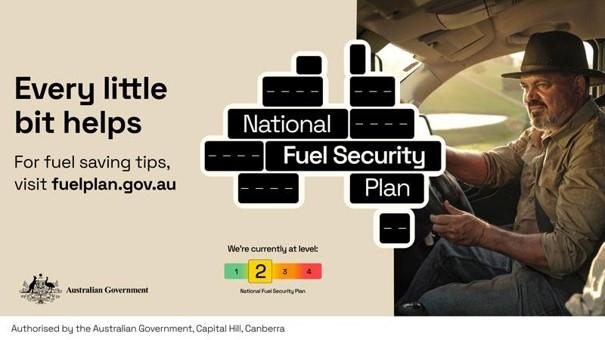
Promotional material for the National Fuel Security Plan.
Image: Prime Minister and Cabinet
Delivering outcomes by intervening at leverage points in complex systems
Multiple actions were undertaken across the APS to form the collective response to the market shock. Key interventions included:
- Leveraging partnerships in the Asia-Pacific region for mutually assured energy security through leader-level and ministerial statements, including in multilateral fora.
- Ensuring robust and timely data collection, analysis and dissemination, including through weekly publication of fuel supply and price information. This information kept households and businesses informed and ensured government was aware of market conditions.
- Supporting, through the Export Finance Australia Fuel and Fertiliser Security Facility, the purchase of cargoes of fuel and fertiliser in tight global markets to sure up domestic supply.
- Engaging with industry stakeholders across fuel supply and demand, through a range of fora to understand challenges and communicate responses.
- Engaging with regulators to ensure the regulatory settings supported the collective response to the market shock. This included the Australian Competition and Consumer Commission and the National Heavy Vehicle Regulator.
These coordinated interventions delivered tangible outcomes. Other actions were also implemented to ensure adequate supply of fuel and other critical materials. These included releasing fuel reserves and amending fuel standards to increase supply and establishing the fuel and fertiliser security facility within Export Finance Australia. By 30 June 2026, Export Finance Australia, working with Australian suppliers, had supported the purchase of:
- 792 million litres of diesel fuel
- 154 million litres of jet fuel
- up to 340,000 metric tonnes of fertiliser.
These actions enabled access to critical, in-demand products and helped underpin Australia's energy and supply security. They did so through strong international partnerships, effective stakeholder engagement, targeted regulatory responses and strategic financing mechanisms.
Critical minerals build Australia’s economic and national security
Critical minerals are crucial to building a Future Made in Australia agenda. They support Australia’s economic sovereignty, defence capabilities, critical technologies and the clean energy transition.
Industry, Science and Resources is helping turn this opportunity into greater onshore processing capability and more resilient supply chains.
A major milestone in realising this opportunity is establishing the Critical Minerals Strategic Reserve (CMSR) following passage of legislation in March 2026. The CMSR will secure the supply of select critical minerals, initially focused on antimony, gallium and rare earth elements, to:
- address supply chain vulnerabilities
- support Australia's economy and national security
- strengthen access to reliable sources of critical minerals for Australia and its partners.
Minerals were selected based on their suitability, priority and potential. This includes minerals:
- with vulnerable supply chains where Australia has the strongest potential to meet demand
- that are most important to national security and economic resilience
- relating to Australian projects in the pipeline that could meet identified needs.
The CMSR also supports collaboration with key international partners to diversify critical minerals supply chains. Partners include:
- Canada
- Europe
- Japan
- Republic of Korea
- United Kingdom
- United States.
The CMSR is already helping advance critical minerals projects. In May 2026, the government provided a non-binding letter of support from the CMSR enabling Arafura Rare Earths to make a final investment decision on its Nolans Project. This paved the way for construction to start in 2026. Once operational, the project will mine and process rare earths in Australia. This will strengthen Australia's capability to supply processed rare earths and capture more value from these resources onshore.
See also in this report
A capable and future ready APS, Building Defence’s internal consulting capability, State of Service Report 2026.
A trusted and accountable APS, Preventing fraud to protect public resources, State of Service Report 2026.
Supporting Australia’s economic future, Building regional workforce resilience, State of Service Report 2026.
Find out more
Department of Industry, Science and Resources (n.d.) Critical minerals, DISR website, accessed 2 September 2026.
Department of Industry, Science and Resources (n.d.) Critical Minerals Strategic Reserve, DISR website, accessed 2 September 2026.
Prime Minister and Cabinet (n.d.) Fuel Supply Taskforce, Fuel Supply Taskforce website, accessed 3 August 2026.
Prime Minister and Cabinet (n.d.) National Fuel Security Plan, National Fuel Security Plan website, accessed 3 August 2026.
Prime Minister and Cabinet (n.d.) Fuel Supply Statistics, National Fuel Security Plan website, accessed 3 August 2026.