



Protecting the environment

Australia faces significant environmental challenges, including climate change, threats to biosecurity, pressure on natural resources, and the growing impact of natural disasters. At the same time, these challenges create opportunities to strengthen resilience, support sustainable economic growth and accelerate the transition to a low-emissions future. Addressing these complex issues requires coordinated action across governments, sectors and communities. This action must be supported by evidence, science and long-term planning.
The APS plays a central role in helping government protect, restore and sustainably manage the environment. Agencies work together across portfolios to deliver policy, regulation, investment and services that support environmental outcomes, drawing on expertise in areas such as climate, energy, agriculture, water, emergency management and infrastructure. Increasingly, agencies are leveraging shared data, research, digital platforms and operational infrastructure to reduce duplication, improve decision-making and deliver more effective, joined-up outcomes.
Australia's complex environmental, climate and resource management challenges
Climate Change, Energy, the Environment and Water works on Australia's most complex environmental, climate and resource management challenges. Departmental staff are guided by shared principles that shape how they make decisions, manage risk and deliver outcomes for Australians.
These principles are reflected in practical actions every day, from reducing emissions and protecting biodiversity to strengthening water management and supporting First Nations partnerships.
Making progress in complex environments
Many of the department's challenges require action before every variable is known. Teams are demonstrating ‘progress not perfection’ by using the best available evidence, adapting to new information and continually improving their work.
This approach is evident in the development by one team of new savanna fire management methods under the Australian Carbon Credit Unit Scheme. Methods combine traditional First Nations fire management knowledge with the latest carbon accounting science. This supports long-term carbon abatement while recognising practices that have sustained landscapes for thousands of years. During 2025–26, the team also released the Savanna Carbon Accounting Model. This new greenhouse gas abatement tool supports project proponents and strengthens the integrity and capability of savanna fire management projects.
The same principle guided preparations for the potential arrival of H5 bird flu outbreak in the Murray-Darling Basin. Recognising that environmental watering decisions could potentially influence waterbird movement, and therefore disease spread, the Commonwealth Environmental Water Holder got to work. It developed a decision-making framework and established an Expert Scientific Panel to ground decisions in the best available science as understanding of the disease evolves. This work strengthens preparedness and environmental water management decision-making capability, supporting broader whole-of-government preparedness efforts.
These examples show how staff balance urgency with evidence, enabling action while remaining responsive to changing circumstances.
Taking considered risks
The work of Climate Change, Energy, the Environment and Water often involves balancing environmental, social and economic considerations. Rather than avoiding risk, staff demonstrate what it means to be risk aware, not risk averse.
In Antarctica, the Australian Antarctic Division acted used a rare access window to rapidly deploy an Autonomous Remote Environment Monitoring System unit to a remote location. Although the available technology was not the newest version, the opportunity to establish long-term monitoring capability outweighed the risks. The deployment will support the collection of valuable environmental and wildlife data from one of the world's most isolated and environmentally sensitive regions.
The department's growing environmental crime capability provides another example. Through operations targeting illegal wildlife trafficking, investigators have strengthened partnerships across jurisdictions and applied specialist expertise to protect Australia's unique biodiversity. During Operation Ramsey, the department achieved its first asset forfeiture arising from an environmental crime investigation is completed, demonstrating its growing enforcement capability.
Environment Information Australia is also demonstrating this principle through the development of integrated information products that draw together multiple datasets. These tools provide richer insights into biodiversity and environmental values. They also help decision makers identify high-value habitat, assess environmental risks, and support transparent, evidence-based decision-making. The enhanced mapping is available publicly, supporting more informed environmental assessments, conservation planning and policy decisions.
Better outcomes through collaboration
Many of Climate Change, Energy, the Environment and Water’s achievements rely on people working across teams, disciplines, portfolios and jurisdictions. The principle that ‘together we're better’ is evident throughout the department’s work.
The review of the Snowy Water Deed has brought together governments, Snowy Hydro, communities and First Nations groups. Together, they are evaluating the effectiveness of existing water management arrangements and investigating improvements that balance the needs of the environment, energy and social outcomes. Joining expertise from water, energy, finance and environmental management has helped identify evidence-based solutions and assess potential implications. Stakeholders and First Nations groups actively participated in the review through deliberative engagement processes that has resulted in practical solutions with strong community support. The final review report was provided to the department at the end of August 2026. Supporting evidence, consultation reports and the outcomes of the deliberative engagement are published on the department’s website.
Collaboration also underpinned the development of the pilot Saving Native Species dashboard. Supporting the Threatened Species Action Plan’s 110 Priority Species and 20 Priority Places, the dashboard draws together information from multiple systems and partners. This provides decision makers with a clearer understanding of progress under the plan and supports more informed policy and investment decisions.
Integrity in decision-making
The Climate and Clean Energy Analytics team demonstrates the principle of integrity over impulse through its work supporting international climate and energy policy.
During the development of Australia's 2035 emissions reduction target, the team analysed rapidly evolving global emissions and energy commitments. Despite significant time pressures, staff maintained rigorous quality assurance processes, testing assumptions, validating data and applying consistent analytical standards. This ensured decision makers had access to credible and comparable international data during a critical period of policy development.
Protecting Australia's biosecurity and export reputation
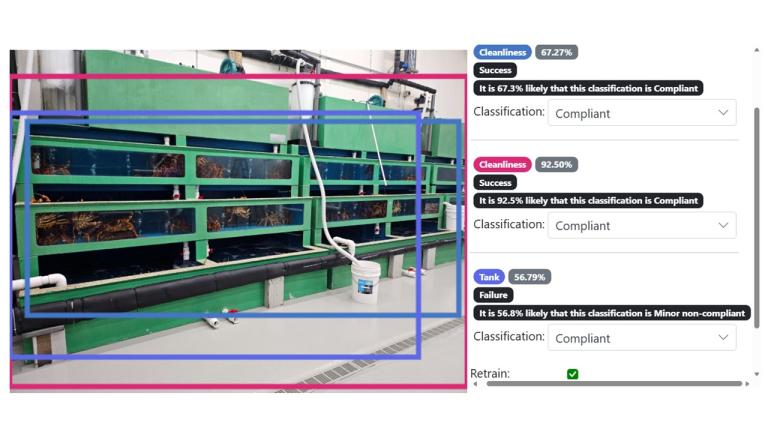
Artificial intelligence analysis of live seafood tanks, trained to determine compliance with export requirements.
Image: Department of Agriculture, Fisheries and Forestry
The Department of Agriculture, Fisheries and Forestry is improving how it supports Australia's exporters by making services simpler, faster and more efficient while maintaining high regulatory standards.
Through digital innovation and close collaboration with industry, the department has modernised key export processes, reducing regulatory burden and helping Australian businesses access international markets more quickly.
One example is the reform of audit arrangements for low-risk dairy, egg and fish export establishments. Working alongside industry, the department designed and implemented a new online audit model that replaces traditional onsite audits. The model is supported by a digital platform that uses artificial intelligence to assist compliance assessments, while maintaining the level of assurance required for food safety and importing country requirements.
The dairy, egg and fish industries have realised direct cost savings of up to $64,978 a year across the industry. This reflects an estimated 50% reduction in departmental regulatory costs associated with audit activities before, during and after audits. This reduction does not include the additional indirect benefits experienced by industry, such as reduced administrative burden, reduced staff time, and improved operational efficiency.
A $2,000,000 estimated benefit for fishing vessels specifically was also achieved as they are no longer required to return to port for audit. This avoided reductions in profits associated with voyage costs and loss of production time when returning to port. This estimate is based on a company’s estimate for their fleet of vessels, which has been multiplied to the entire sector.
The department has also strengthened support for businesses seeking to enter export markets through its Export Facilitation Service. Dedicated facilitators for dairy, egg and seafood exporters work directly with businesses to help them understand export requirements and navigate regulatory processes and the export registration process.
This tailored support has significantly reduced the time taken for new exporters to achieve export registration (from approximately 10 months to 3 months), helping businesses access international markets sooner and realise the benefits of export opportunities more quickly. At the same time, greater awareness of regulatory obligations supports stronger compliance outcomes across the sector.
Improving climate reporting and transparency
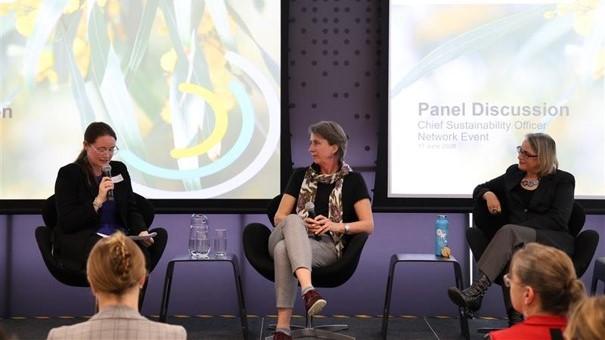
Chief Sustainability Officer Network event in June 2026, featuring a panel with Finance, SBS and the Australian Climate Service.
Image: Finance
The APS is reducing emissions across its operations while improving transparency in climate reporting and disclosure. This work is progressing the APS Net Zero 2030 Target and is guided by the Net Zero in Government Operations Strategy.
In 2025–26, Finance strengthened Australia’s whole-of-government approaches to emissions reporting and climate-related transparency. The work is helping entities report more consistently and better connect emissions data, climate risk management and emissions reduction planning.
Key achievements included:
- Launching the Emissions Data Portal, providing a secure and streamlined way for entities to submit emissions data. The portal helps improve data quality, validation and reporting efficiency. A trial with 19 Commonwealth entities helped test the portal and prepare for broader implementation for 2025–26.
- Expanding the Transparency Portal to include Commonwealth entities’ climate disclosures and emissions inventories. New functionality supports standalone climate disclosure reports and emissions inventories as interrogable datasets, improving public access to climate-related information.
- Improving climate disclosure support through practical guidance, tailored advice, a climate disclosure review service and compliance checks of draft disclosures.
- Embedding emissions reduction planning across government. As of June 2026, every entity in-scope for the 2030 Target had developed an organisational Emissions Reduction Plan, outlining actions to reduce operational emissions.
- Building climate capability across the APS through the Climate Action in Government Operations Education Program on APS Learn. The program includes 8 e-learning courses covering practical aspects of climate action in government operations. A partnership with RMIT Online also delivered 2 Greening Government Microcredentials. These are helping build skills to apply climate considerations across areas such as property, fleet, procurement and emissions reporting.
- Strengthening collaboration across government through the Chief Sustainability Officer Network and the Climate Action in Government Operations Community of Practice. These forums support knowledge sharing, collaboration and access to guidance and resources. The Chief Sustainability Officer Network includes more than 100 participating Commonwealth entities and companies. The Community of Practice has more than 900 members across 174 Commonwealth entities and companies.
See also in this report
AI and digital innovation, Innovative approaches to data in the Australian Antarctic Data Centre, State of Service Report 2026.
Serving the Community, Community engagement shapes the future of the Murray-Darling Basin, State of Service Report 2026.
Find out more
Department of Agriculture, Fisheries and Forestry (n.d.) Low-risk audits for dairy, eggs and fish establishments, DAFF website, accessed 2 September 2026.
Finance (n.d.) Climate Action in Government Operations, Finance website, accessed 1 September 2026.