



A safe, reliable health system

A safe and reliable health system people can depend on is essential to the wellbeing of Australians. The APS plays an important role in ensuring the health system is safe, dependable and capable of delivering care when people need it.
Across the health system, APS agencies are putting trust, integrity and stewardship into practice. Their work helps strengthen patient safety, secure essential supplies, build resilience and support effective public health oversight.
Good stewardship means looking beyond immediate challenges and preparing the health system for the future. It means working with health professionals, providers, industry and communities to identify risks, respond to emerging issues and keep essential services operating.
The APS also supports strong systems and safeguards that help protect patients and maintain confidence in health services. Effective oversight, reliable information and clear accountability help identify problems early and support better decisions.
Strengthening cyber resilience across the health system
Infographic from the Digital Health Cyber Champion Network.
Image: Australian Digital Health Agency
The Australian Digital Health Agency launched the Cyber Champions Program in August 2024 to strengthen cyber security across the health system. By 2026, it had built a network of 141 participants across 113 healthcare organisations, helping protect Australians’ health information and support safe, connected care. This is increasingly important as Australians rely on digital health services to access care, share information and support clinical decisions.
The Cyber Champions Program equips healthcare professionals to become trusted local champions for cyber safe practice. Interactive, instructor-led online sessions cover real-world risks, including:
- phishing and ransomware
- business email compromise
- social media and digital footprints
- supply chain risk and vendor management.
Participants learn to recognise threats, protect systems and information, support incident response planning and promote safer cyber behaviours in their workplaces.
The program’s community-led model is central to its impact. Rather than treating cyber security as a one-off compliance task, it connects national expertise with frontline experience, helping organisations turn national guidance into practical action. Participants understand the pressures and risks in their own settings, while the agency provides structured training, practical resources, current advice and national leadership.
Participants span the breadth of Australia’s health system, including:
- Aboriginal Community Controlled Health Organisations
- aged care and disability services
- allied health
- ambulance services
- general practice
- health software providers
- hospitals
- medical imaging
- pathology
- pharmacy
- Primary Health Networks
- specialist healthcare providers
This broad participation helps strengthen cyber capability across metropolitan, regional and smaller practice settings.
The program is offered at no cost, reducing barriers to participation and supporting equitable access to cyber capability. After induction, champions remain connected through the Cyber Champions Network, receiving ongoing resources, updates and opportunities to share insights. This helps make cyber security part of everyday practice and supports a stronger, shared cyber culture across the sector.
For Australians, stronger cyber resilience means greater confidence that personal health information is protected, and digital systems support safe, connected care when services are under pressure.
Building a safer medical device identification system
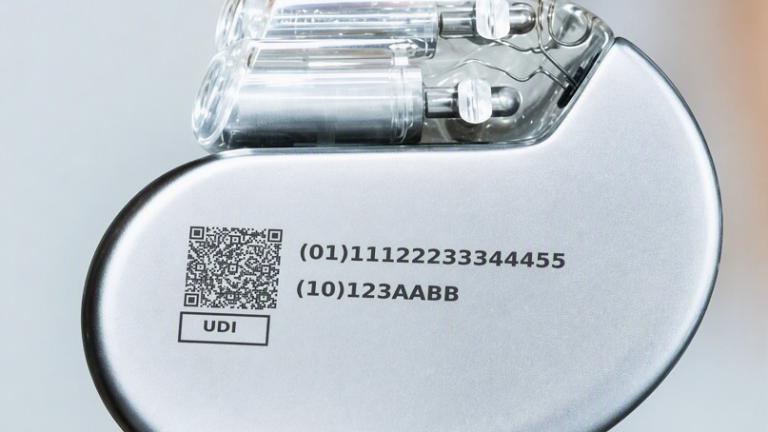
Australian Unique Device Identification system.
Image: Health, Disability and Ageing
When a medical device such as a pacemaker or hip joint fails, every minute counts. Australia’s health system has historically faced challenges quickly identifying affected devices, where they were used and which patients received them.
Through amendments to the Therapeutic Goods (Medical Devices) Regulations 2002, the Therapeutic Goods Administration (TGA) introduced unique device identification requirements for medical devices. From 1 July 2026, medical device manufacturers are required to label devices with a unique identifier. This identifier and related information are available through the Australian Unique Device Identification Database (AusUDID), a free, public source of data for healthcare providers, patients and registries. Together, the identifier and data form the Unique Device Identification (UDI) system, providing an internationally consistent way to identify medical devices in Australia.
The TGA designed the UDI as 4 connected streams: regulation, digital delivery, stakeholder engagement and healthcare adoption. Progressing these streams together joined regulatory reform, digital infrastructure and sustained collaboration across the health system. This created a national data capability that supports safer care and better decision-making.
The TGA established the regulatory framework and delivered the AusUDID, which continues to grow and evolve. More than 310,000 device records are now in the database, demonstrating strong industry adoption and building a public source of trusted device information. Manufacturers provide the UDI through device labels and patient implant cards, while healthcare providers and clinical quality registries can record the information in clinical systems.
Delivery involved international device regulators, device manufacturers, Australian device suppliers, hospitals, clinicians, clinical quality registries, state and territory governments, patients and consumers. Regulatory, digital and policy teams worked together to ensure the system was technically robust and practical to use. Real-world pilots and early adopter programs also helped test UDI in clinical settings and refine the approach using local and international experience.
For Australians, the UDI delivers its greatest value when safety issues occur. Healthcare providers and registries can use it to accurately identify affected devices and patients, enabling faster action to stop supply, reduce harm and support safer clinical decision-making.
For patients, the UDI provides a clearer long-term record of implanted devices. It can be included on patient implant cards, shared with a general practitioner or recorded in My Health Record.
By making device information publicly available at no cost, AusUDID is laying the foundation for a more connected, transparent and data-driven healthcare system.
National coordination for access to essential medicines

Team members from the Medicine Shortages Section, Therapeutic Goods Administration.
Image: Health, Disability and Ageing
The Medicine Shortages Section at the Therapeutic Goods Administration (TGA), part of Health, Disability and Ageing, monitors Australia’s medicine supply. It also works to reduce the impact of shortages on patients and healthcare professionals. Medicine shortages can have a real impact on health and wellbeing, making access to the medicines Australians need essential.
A recent example is the response to the intravenous (IV) fluid shortage, a complex disruption affecting all parts of the health system that commenced in 2024 and resolved in 2026. Medicine Shortages Section rapidly assessed and approved 29 overseas alternative IV fluid products. It also coordinated national supply modelling to inform conservation measures and maintain patient access.
The response brought together:
- state and territory health departments
- 9 sponsors – 3 major IV fluid sponsors and 6 supplying overseas alternatives
- National IV Fluids Response Group
- Australian Commission on Safety and Quality in Health Care
- international medicine regulators.
Alongside managing the shortage, the Medicine Shortages Section progressed legislative reforms throughout 2025 and 2026. It did so to strengthen medicine shortage reporting, improve visibility of critical medicines and support earlier intervention. The reforms team worked alongside the operations team to update the Reportable Medicines Determination to bring IV fluids into the reporting framework. This was supported by a public consultation and significantly improved visibility and monitoring of IV fluid supply in Australia.
The Medicine Shortages Section consolidated information through national forums and communication channels to support a shared understanding of potential impacts and risks. For the IV fluid shortage, these included:
- National IV Fluids Response Group
- Medicine Availability Working Group
- Medicine Shortages Stakeholder Forum
- TGA public alerts.
The TGA met with stakeholders in forums more than 40 times across 2024 to 2026. Medicine availability modelling was conducted 6 times to assess Australia’s IV fluid supplies. Modelling relied on the voluntary sharing of supply and demand data from sponsors, jurisdictions and healthcare providers. This demonstrated the strong relationships and trust the TGA’s Medicine Shortages team has built across the sector.
The TGA’s response ensured Australians continued to have access to essential hospital medicines during a prolonged global supply disruption. Supply has now stabilised, and the shortage was resolved on 22 June 2026.
Reforms to include IV saline fluids in the Reportable Medicines Determination improved visibility of supply and strengthened the TGA’s ongoing monitoring. This has improved Australia’s ability to identify risks earlier and respond more effectively to future disruptions.
Australian Immunisation Register
The Australian Immunisation Register (AIR) is a national system that records vaccinations for everyone in Australia. Services Australia delivers it in partnership with Health, Disability and Ageing, vaccination providers, state and territory health authorities, and a broad network of health, research and technology partners.
Taking an integrated approach to immunisation, the AIR connects individuals, healthcare providers and governments through a single, trusted source of vaccination information. This helps Australians access their immunisation history, receive reminders when vaccinations are overdue, and obtain proof of vaccination for school, childcare, work and travel. Healthcare providers can view a person’s vaccination history to support informed clinical decisions. Governments can use AIR data to monitor vaccination coverage and respond to emerging health risks.
The AIR evolved from a childhood register into a whole-of-life system in 2016. This change created a more complete view of immunisation across a person’s life and strengthened Australia’s ability to plan and respond to public health needs.
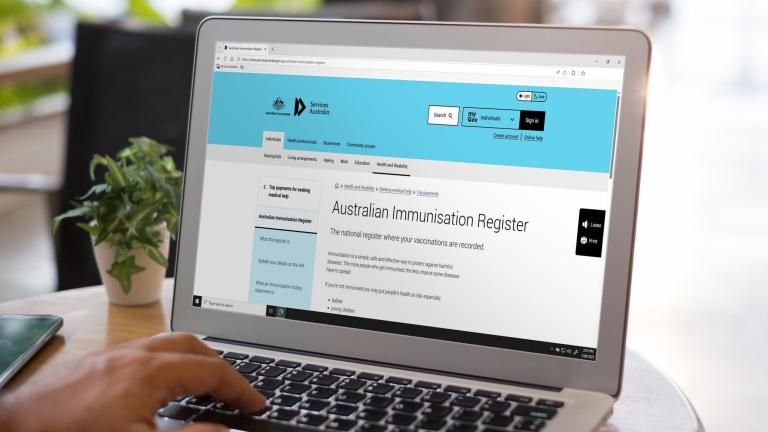
Laptop displaying the Services Australia Australian Immunisation Register information page.
Image: Services Australia
The system relies on collaboration across government and the broader health system. Within Services Australia, multidisciplinary teams work together across provider engagement, policy and governance, operations, digital delivery and system improvement. External partners contribute policy direction, immunisation data, digital integration, research, and specialist expertise. Regular engagement and shared decision-making align policy, service delivery and system capability.
This collaborative model also supports continuous improvement. Engagement with vaccination providers helps improve data quality and reporting, while partnerships with software vendors enable secure and efficient reporting from clinical systems. Research and health partners provide insights that help identify risks, improve vaccination coverage and inform public health responses.
The AIR has supported records for more than 44 million individuals and captured more than 366 million vaccination events. It has generated more than 241 million immunisation history statements, including up to 3.2 million in a single day during periods of high demand.
AIR data also supports national immunisation monitoring and planning, with just over 93% of children aged 0 to 6 years fully vaccinated in 2026 (as at 31 Aug 2026).
By bringing together people, data, digital systems and expertise, the AIR provides a simpler and more connected service for Australians. It does so while supporting better public health decisions and more responsive government.
See also in this report
A healthy and safe Australia, Safer interactions while supporting customers with complex needs, State of Service Report 2026.
A healthy and safe Australia, Safeguarding access to affordable and high-quality medicines, State of Service Report 2026.
Find out more
Australian Digital Health Agency (2026) Are you ready to be a cyber champion?, Digital Health website, accessed 30 August 2026.
Health, Disability and Ageing (n.d.) Unique Device Identification (UDI) hub, Health website, accessed 30 August 2026.
Health, Disability and Ageing (2025) Improvements to managing medicine shortages and discontinuations, Health website, accessed 1 September 2026.
Health, Disability and Ageing (2026) Immunisation dashboards, Health website, accessed 11 September 2026.
Services Australia (2025) Australian Immunisation Register, Services Australia website, accessed 11 September 2026.