



Protection and support for people experiencing vulnerability

People can face times when navigating government systems feels difficult, overwhelming or unequal. The APS plays an important role in making sure they can access the support and services they need, particularly when experiencing vulnerability.
APS agencies work to make systems easier to navigate and respond to people’s different circumstances. This includes providing clear information, accessible services and appropriate support for those who may be dealing with complex or traumatic experiences.
Good public administration recognises that people do not always start from the same place. Services need to be designed around their needs and delivered with care, fairness and respect.
Across the APS, this work helps people understand their options, access essential services and have their needs considered when decisions are made. It also helps agencies identify where systems may create barriers and improve how services respond.
These efforts demonstrate how integrity, stewardship and a focus on people can make government services more accessible, fair and responsive for those who need support most.
Improving outcomes for survivors through the new application pathway
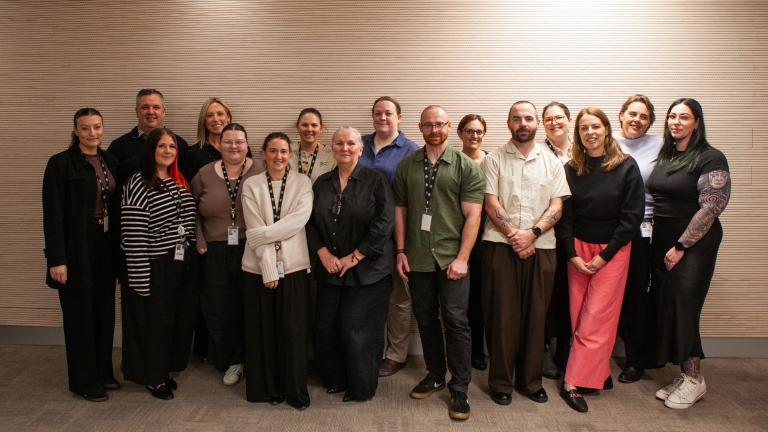
National Redress Scheme team members. Back row, from left: Jaimee Cordina, Todd Wilson, Amy David, Melissa Cavenagh, Nerrida Poke, Amelia Brassington, Kelly Ters, Melissa Sleegers, Tiana Cassimaty. Front row, from left: Tenille Vaughan, Emily Gervaise, Laura Creighton, Tina Buecher, Bradie Logue, Keiran Evans, Olivia van Woerden. Absent: Amber Hidasi, Sarah Hussein, Jasmin Lyneham, Jess Mercia, Tori Panoutsopoulos, Kris van Oorde.
Image: Department of Social Services
The National Redress Scheme was established in response to the Royal Commission into Institutional Responses to Child Sexual Abuse. It supports people who have experienced institutional child sexual abuse in many ways. This includes through:
- redress payments
- counselling and psychological care
- a direct personal response from the responsible institution where chosen (which gives the person an opportunity to have their experience of abuse and its impacts acknowledged in a meaningful way).
Introduced in February 2026 by the Department of Social Services, a new application pathway is helping improve the experience of people seeking redress. It is also enabling new applications to move through the process quickly, predictably and with greater care.
Applicant experience is already improving. While applications across the scheme take an average of 16 months to finalise, the new application cohort managed through the pathway has reduced this timeframe to 72 days.
Thirteen weeks after the scheme launched, 1,322 applications were allocated to end-to-end processing. This showed strong demand for the scheme and the value of focused operational reform for survivors navigating a complex service system.
The application pathway combines rapid resolution, proactive telephone contact and fewer handovers. By focusing on impact rather than process completion, it:
- gives staff clearer visibility of application progress
- strengthens triage and decision-making authority
- uses data and quality assurance to support consistent outcomes
- reduces handovers between teams
- applies a consistent, trauma-informed approach
- keeps staff focused on applicant outcomes.
For survivors, the pathway means less time waiting for an outcome and a more coordinated application experience. It also provides a practical model for managing complex applications in a way that improves visibility, supports timely action and reduces unnecessary delays.
While the pathway focuses on managing incoming applications, other specialised teams continue to progress applications on hand, enabling multiple streams of work to progress concurrently. Importantly, lessons and improvements identified through the new application pathway are being incorporated more broadly across scheme operations. This includes application processing approaches used for existing applications, older applications and complex cases.
The National Redress Scheme began in 2018 and is due to close in 2028. Its application pathway provides a practical, scalable model, while providing timely and consistent support for survivors.
Enhancing police responses to family, domestic and sexual violence
The Attorney-General’s Department has been working with state and territory police organisations, as well as government, academic and non-government stakeholders, on a new national training package. A first-of-its-kind, the new package enhances police responses to victims and survivors of family, domestic and sexual violence (FDSV).
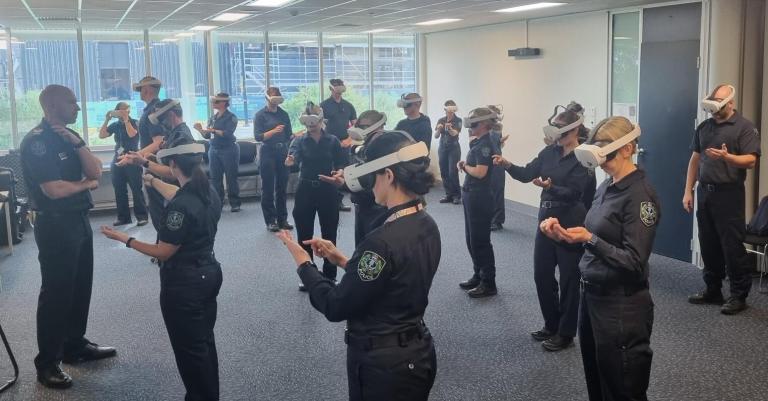
Honour, Enhance, Acknowledge, Respond training participants from South Australia Police.
Image: Attorney-General's Department
The HEAR (Honour, Enhance, Acknowledge, Respond) Training Program is an immersive education package. It is informed by research expertise, local training needs, and the experiences of FDSV victims and survivors. One in 4 women experience violence by a partner or family member, and one in 5 experience sexual violence. With these statistics in mind, police play a critical role in ensuring victims and survivors are safe and that perpetrators are held to account.
HEAR training uses virtual reality and 360-degree video case studies to explore the experiences of FDSV victims and survivors and identify opportunities to achieve better outcomes. Police receive training on topics including:
- identifying the primary aggressor to reduce instances of misidentification
- understanding coercive control
- recognising indicators that can help identify more subtle forms of FDSV, such as technology-facilitated abuse.
The training program also includes content on culturally safe policing practices to minimise retraumatisation.
HEAR training is delivered through facilitated face-to-face sessions, facilitated virtual sessions, and online self-paced learning through a secure, custom-built learning management system.
The development of the training package represents a truly innovative and collaborative effort involving community, not-for-profit, non-government, academic and government stakeholders. Extensive consultation, research and testing ensured the package meets the needs of police operating in diverse contexts. It ensured the package, reflects best-practice evidence in adult learning. It also ensured the package incorporates the experiences of people with lived experience of FDSV who have sought assistance from, or had interactions with, police. This includes, but is not limited to, Aboriginal and Torres Strait Islander peoples, culturally and linguistically diverse communities, people with disability, and LGBTQIA+ communities.
This training is set to be delivered to thousands of police officers across Australia throughout 2026.
Social security debt waiver laws and people experiencing vulnerability.
Changes to social security debt waiver laws are improving outcomes for people experiencing vulnerability. In November 2025, the government passed reforms that expanded Services Australia’s ability to waive debts in special circumstances and increased the threshold for waiving small debts for the first time in 30 years.
The special circumstance changes took effect from 5 December 2025. In 2025–26, a total of 14,624 debts were waived, an increase of almost 2,450 from 2024–25.
The small debt waiver increase took effect from 20 March 2026. On 25 March, a one-off waiver of potential debts with a value less than $250 resulted in more than 970,000 potential debts being removed from the backlog. In total, 1,205,567 small debts were waived in 2025–26.
The reforms enable Services Australia to better respond to people in complex situations when considering if a debt should be waived. Such situations include family and domestic violence, coercive control, and financial abuse. Often these challenges co-occur with other barriers to service access such as mental ill-health, language barriers and social isolation. Reforms also extend to customers experiencing natural disasters and other serious life pressures.
This work was delivered through strong collaboration between Services Australia and its policy partner, the Department of Social Services. Teams from across both agencies contributed policy and legislative advice, frontline operational insight, technical expertise, quality assurance, customer insight, and communication support. Together, these agencies simplified guidance, improved decision-making pathways, updated operational materials, and introduced clearer communication for customers. This coordinated approach helped staff apply the new provisions consistently while better supporting people in vulnerable situations.
To support consistent decision-making and provide the right support to staff and customers, delivery was rolled out in 2 stages. For the first 6 months, requests under the new legislation were triaged to a specialist multidisciplinary team comprising skilled and trained staff, including social workers. Staff received targeted family and domestic violence training. The team worked closely with Indigenous and Remote Servicing areas to consider the needs of First Nations and remote customers.
The staged approach provided early insight into real customer experiences and allowed feedback from cases to shape practical improvements to the final process. It also enabled close monitoring of implementation, the capture of lessons learned, and refinement of processes before broader rollout.
These reforms ensure that people experiencing hardship and serious vulnerability are treated with fairness, dignity and care. They also strengthen trust in government by demonstrating that the agency responds to individual circumstances in a practical and compassionate way.
Safer interactions while supporting customers with complex needs
Services Australia tailors service delivery to individual circumstances while maintaining staff safety and service integrity.
Personalised Services is a specialised management stream within Services Australia. Its contact officers provide intensive phone-based support to customers with complex needs, challenging behaviours or extreme vulnerability. Customers may have limited access to support if they are experiencing:
- banking barriers
- family and domestic violence
- homelessness
- incarceration
- lack of identification
- mental health concerns
- or other circumstances.
Specialised contact officers use a combination of risk management, trauma-informed engagement, tailored service planning and advocacy to improve outcomes for vulnerable Australians. This work supports access to income support and identifies systemic barriers affecting customers with complex needs.
Collaboration is key. Officers partner closely with multiple entities to address housing instability, financial exclusion, welfare concerns and access to health care. This includes partnerships with social workers, allied health professionals, specialist teams and external partners, including banks, community organisations, health services, legal advocates, police, correctional services, NDIS providers and other government agencies.
A recent shift in practice for officers has been the adoption of a strengths-based approach, supported by tailored training from a psychologist. The introduction of vicarious resilience is recognising the positive impacts of seeing people respond to and recover from life's challenges. It has helped officers acknowledge customer strengths, resilience and capability, rather than focusing solely on trauma and vulnerability. It has also strengthened staff wellbeing.
Beyond resolving enquiries, officers help protect access to income, housing stability, safety and government support. By coordinating tailored assistance and advocating across services, officers reduce risk, improve outcomes and contribute to safer interactions. The approach builds trust, strengthens accessibility and provides valuable insight into the challenges faced by some of Australia's most vulnerable customers.
See also in this report
Serving the community, Making tax and superannuation systems more accessible for people experiencing vulnerability, State of Service Report 2026.
Find out more
Australian Institute of Criminology (2024) Police training in responding to family, domestic and sexual violence, Australian Institute of Criminology website, accessed 23 August 2026.
Department of Social Services (2026) DSS Impact Strategy 2025–2030, DSS website, accessed 21 August 2026.
Department of Social Services (2025) National training and education package to enhance police responses, DSS website, accessed 23 August 2026.
Department of Social Services (2026) National Plan to Reduce Violence against Women and Children, DSS website, accessed 23 August 2026.
7NEWS (2026) Police across Australia to use world-first virtual reality training for family violence callouts, 7NEWS website, accessed 23 August 2026.
Services Australia (2026) Improving how we support people with Centrelink debts, Services Australia website, accessed 19 August 2026.
Services Australia (2026) Vulnerability Strategic Commitment, Services Australia website, accessed 11 September 2026.