



Accessible and affordable primary healthcare

Australia’s healthcare system continues to evolve to meet community needs and manage growing demand. Strengthening Medicare through national urgent care clinics, 1800MEDICARE, increased bulk billing, and cheaper medicines is improving access to healthcare for all Australians.
Fast, bulk-billed treatment without the hospital trip

The Medicare Urgent Care Clinics program won the 2025 Institute of Public Administration Spirit of Service Commonwealth Superannuation Corporation People’s Choice Award.
Image: Health, Disability and Ageing
Medicare Urgent Care Clinics mean millions of Australians now have faster access to treatment for urgent but non-life-threatening conditions, reducing demand on hospital emergency departments. Patients are treated for concerns like minor fractures, wounds and burns. Extended opening hours and no out-of-pocket costs mean patients in need have an alternative to busy hospital emergency departments.
The clinics are a product of Health, Disability and Ageing collaborating across federal, state and territory governments, primary health networks and service providers to make it easier to access healthcare for millions of Australians. Providing care for people with urgent, but less complex conditions, supports hospitals to focus on treating more serious conditions.
Since the first clinic opened in June 2023 and to 30 June 2026, more than 3.3 million presentations were recorded across Australia. Interim evaluations conducted in 2025–26 indicate that the clinics are reaching intended patients and contributing to a reduction in demand for emergency departments. Evaluation findings include:
- An estimated 10% decrease in comparable emergency department presentations, suggesting that clinics are helping divert some people with less urgent health needs from emergency departments and into more appropriate care.
- Around 30% of visits occur on weekends, with survey findings demonstrating that access to after-hours care outside traditional general practitioner hours is a key reason for visiting an urgent care clinic.
- Over 1 in 4 visits have taken place on the weekend and approximately 25% of visits occur after 5 pm on weekdays. This highlights the value of extended operating hours for people who need care outside standard business hours.
APS staff in the Urgent Care Branch and across the department play a critical role in delivering and monitoring the Medicare Urgent Care Clinic program. They achieve this by combining data driven decision-making, stakeholder collaboration and strong governance.
1800MEDICARE – 24/7 health support with a call or click
On 1 January 2026, 1800MEDICARE launched as a free, 24/7 national health service providing health information, advice and connections to appropriate care. People can speak to a registered nurse by calling 1800MEDICARE (1800 633 422), visiting medicare.gov.au/1800 or using the 1800MEDICARE app.
Delivered through Healthdirect Australia, registered nurses assess symptoms, provide health advice and connect callers with appropriate care. Depending on clinical need and time of day, callers may be referred to their general practitioner (GP), a Medicare Urgent Care Clinic, an emergency department or a 1800MEDICARE GP telehealth consultation. The service provides an alternative pathway to care, particularly in the after-hours period and in rural, regional and remote communities.
Between 1 January and 30 June 2026, a total of 699,118 people received free health information and advice from a nurse through 1800MEDICARE and associated Healthdirect services. Of these, 33,071 went on to have a free telehealth consult with a 1800MEDICARE GP. The service also helped 101,316 people avoid an unnecessary trip to the emergency department or 000 call, safely diverting 63.3% of people who intended to go to an emergency department or call 000.
The 1800MEDICARE app provides people with secure access to their electronic prescriptions and Active Script List, and key health information uploaded to their My Health Record. The app and website also provide access to digital tools, including a Service Finder and Symptom Checker. These tools allow people to find and book services, check their symptoms and search for trusted health information.
Medicare incentives for more bulk billing
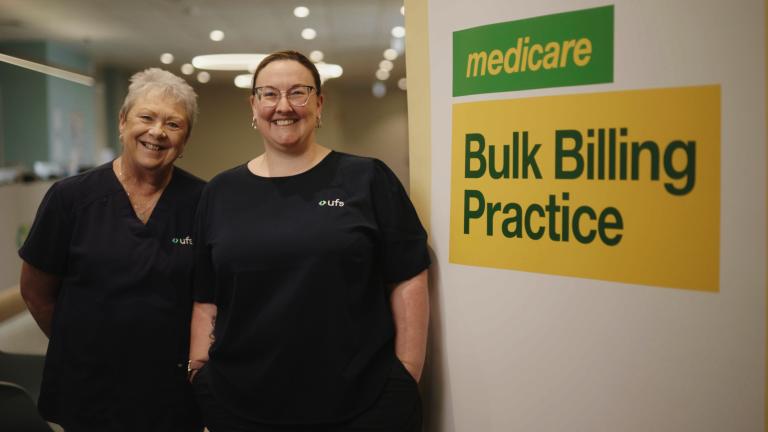
Staff at a recently registered Bulk Billing Practice Incentive Program practice, with Medicare Bulk Billing Practice signage.
Image: Health, Disability and Ageing
Changes to the Medicare Benefits Schedule have expanded eligibility for bulk billing incentive items to all Medicare-eligible patients. A new incentive program, the Bulk Billing Practice Incentive Program, supports increased bulk billing. It does so by providing participating practices with an additional 12.5% incentive payment on eligible MBS services when they bulk bill all eligible patients. This is shared between the practice and the general practitioner (GP).
Delayed or avoided GP visits can result in poorer health outcomes and increased demand on hospitals due to preventable conditions. In recent years, declining bulk billing rates and rising out-of-pocket costs have affected access to primary care. After hitting a high-point during the COVID-19 pandemic, the bulk billing rate for GP non-referred attendances fell from 88.8% to 77.3% in 2025. Over the same period, total patient out-of-pocket costs more than doubled, from $780 million to $1.66 billion. So did the proportion of people delaying or deferring GP care due to cost, from 3.5% to 8.8%.[3]
Expanding bulk billing supports earlier diagnosis and treatment in primary and preventive healthcare. From 1 November 2025, bulk billing incentives became available for all Medicare patients. Previously, eligibility was limited to children under 16 and people holding Commonwealth concession cards. These measures have increased the national GP non-referred attendance bulk billing rate. It rose to 84.1% during April to June 2026, a 4.9 percentage point increase compared to the same period 12 months before. Outside of the COVID-19 pandemic, this is the largest year-on-year quarterly jump in bulk billing in 20 years. As a result, approximately 97% of Australians are now within a 20-minute drive of a registered Medicare bulk billing practice, improving access to affordable care for all Australians.
APS agencies, including Health, Disability and Ageing and Services Australia, collaborated closely with health sector partners to design, implement and deliver on the intended outcomes of the policy. To support participation in the Bulk Billing Practice Incentive Program, participation, Health, Disability and Ageing has developed tools to help practices assess eligibility, understand the financial benefits of participating and monitor progress towards incentive payments. These include the:
- Bulk Billing Incentives Calculator with prefilled data to help busy healthcare providers and businesses calculate their expected incentive revenue
- Eligibility Assessment Forecast Tool to support practices track progress against program requirements and forecast their eligibility for incentive payments.
The Bulk Billing for All Australians Mapping Tool allows patients to enter their postcode and find a bulk-billing practice near them, making it easier to access affordable health care services.
APS staff delivered targeted communications, including more than 6,600 tailored letters through Health Professional Online Services. Letters explained the reforms and provided indicative financial modelling. Partnerships helped target communications and support across the sector. This included with the Australian Association of Practice Management, the PHN Cooperative, the National Aboriginal Community Controlled Health Organisation and other networks.
A national webinar series brought together policy, data and service delivery experts to turn complex policy and modelling information into practical guidance. More than 4,000 people registered and nearly 3,000 attended, helping GPs and practice managers make informed decisions.
Together, these efforts strengthened practice readiness, supported diverse primary care providers and contributed to strong early uptake of the program, exceeding initial projections.
Footnote
[3] Australian Bureau of Statistics. (2024). Patient Experiences, 2023–24, Australian Bureau of Statistics ↩ Return to text
Safeguarding access to affordable and high-quality medicines
The Pharmaceutical Benefits Scheme helps Australians access medicines at a lower cost. From 1 January 2026, the co-payment for general patients fell to $25, alongside new and amended listings for a range of medicines.
Cheaper medicines support more Australian patients to fill the scripts that their health practitioners have said are important for their health. This ensures that more Australians have timely, safe and reliable access to the effective high-quality medicines they need. At a public health level, reforms that improve patient access to the right medication can reduce the burden of chronic disease and deliver better health outcomes.
People not taking their medicines as prescribed has significant impacts on patient health outcomes and health system expenditure. In 2024–25, the Australia Bureau of Statistics’ Patient Experience Survey showed that cost was a barrier to filling prescription medications for 7.5% of Australians. The 2025–26 survey data was not available when this report was prepared.
These reforms support Australians to purchase the medicines they need. Reducing the co-payment to $25 provides a saving of over 20% on the maximum charge for general patients who need medicines that previously cost $31.60 per prescription. New and amended medicines in 2025–26 included the world’s first single PBS listings for nivolumab (Opdivo®) and ipilimumab (Yervoy®) to cover multiple advanced cancers. This makes it easier and faster for patients to access immunotherapy.
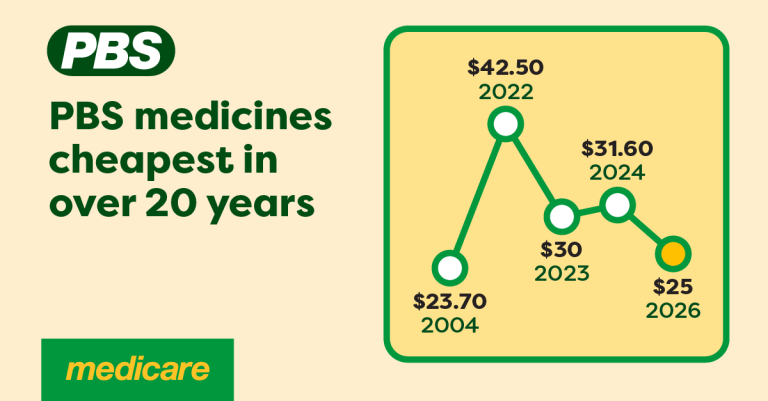
Infographic from the Pharmaceutical Benefits Scheme price reduction campaign.
Image: Health, Disability and Ageing
Delivering cheaper medicines for Australians is a joint effort between Health, Disability and Ageing and Services Australia. APS implementation of the $25 co-payment initiative was supported by a public communications campaign featuring a multi-pronged media strategy. Listing of new and amended medicines on the Pharmaceutical Benefits Scheme by Health, Disability and Ageing helped all eligible Australians. It did so by providing reliable, timely, and affordable access to high-quality, clinically effective, cost-effective medicines recommended by the Pharmaceutical Benefits Advisory Committee.
See also in this report
A healthy and safe Australia, Australian Immunisation Register, State of Service Report 2026.
A healthy and safe Australia, National coordination for access to essential medicines, State of Service Report 2026.
Find out more
Australian Bureau of Statistics (2025) Patient Experiences, ABS website, accessed 25 September 2026.
Australian Bureau of Statistics (2025) Patient Experiences – data downloads, ABS website, accessed 25 September 2026.
Health, Disability and Ageing (2026) Find your nearest Medicare Urgent Care Clinic, Health website, accessed 30 June 2026.
Health, Disability and Ageing (2026) Bulk billing incentives in general practice, Health website, accessed 30 June 2026.
Health, Disability and Ageing (n.d.) Bulk Billing for all Australians, Health website, accessed 9 September 2026.
Health, Disability and Ageing (2026) 1800MEDICARE health advice, Health website, accessed 4 August 2026.
Health, Disability and Ageing (2026) 1800MEDICARE Video, Health website, accessed 4 August 2026.
Health, Disability and Ageing (2026) PBS Co-Payments Cheaper Medicines, Health website, accessed 4 August 2026.
Health, Disability and Ageing (2026) PBS Price Reduction Fact Sheet, Health website, accessed 4 August 2026.
Health, Disability and Ageing (2026) World First Immunotherapy Treatment Listing , Health website, accessed 4 August 2026.