



Strengthening APS capability to deliver

Navigating unexpected events and rapid change requires an APS that can identify emerging signals, explore multiple possible futures, and prepare before crises occur. It must be anticipatory, adaptive, digital by design and outcomes focused.
At the same time, the APS must continue to deliver services reliably, equitably and ethically. It must also continue to fulfil legislative and statutory obligations; and demonstrate transparency and trustworthiness across its functions. These responsibilities do not diminish in times of disruption. Indeed, the need for responsive, transparent and reliable public services often increases.
The APS has been achieving this through:
- strategic workforce planning, especially in the context of artificial intelligence
- its Capability Review Program which covers overall progress and key insights as the service matures
- embedding and scaling in-house capability.
Lifting workforce planning maturity across the APS
Workforce planning maturity is a measure of how well an organisation understands, plans for and manages its workforce to meet future service delivery needs. For APS agencies, this critical capability supports performance and accountability obligations and enables delivery of government priorities.
As rapidly evolving technologies reshape work, mature workforce planning is increasingly a strategic imperative. It is central to how agencies reskill and redeploy their workforce to maintain effective, efficient and sustainable service delivery.
The APS Workforce Strategy and Planning team within the Australian Public Service Commission uses biennial assessments of agency workforce plans to identify capability gaps and target support activities. Assessments consider the plan itself and its use of data. They also consider evidence to identify priorities and arrangements for delivery and implementation. This includes integration with broader organisational processes, accountability and measurement.
Baseline assessments in 2021 identified 2 key maturity gaps: use of data and evidence; and implementation. Over one-third (36%) of assessed plans did not draw on evidence, while three-quarters had limited targets or accountability mechanisms.
To help agencies address these gaps, the team delivered a Workforce Planning program with targeted capability uplift between 2021 and 2025. It did so through:
- 21 in-depth analyses across 12 job families, showcasing best-practice workforce insights and highlighting workforce risks that supported agency workforce planning
- 22 workforce analysis seminars and masterclasses, providing training and capability uplift to close identified workforce planning gaps
- 12 workforce planning forums, supporting peer-to-peer learning
- expansion of the Workforce Planning Resources Hub
- updated metrics and reporting guidance for workforce planners to build foundational workforce analysis capability
- 36 foundational (start-up) and technical (boost) courses through the APS Academy.
Results in 2025–26 showed significant improvements in foundational workforce planning capability. More agencies reported having or developing a workforce plan than in 2021 (81%, up from 72%). The use of evidence to inform workforce priorities increased substantially, with 97% of plans drawing on evidence. Among developed plans, implementation also improved through stronger integration with business planning and clearer targets for monitoring and evaluation.
Analysis showed that agencies engaging with the team and Workforce Planning program demonstrated greater improvements in workforce planning maturity than those that did not. This reinforces the value of targeted support in lifting workforce planning capability across the APS.
Generating system-wide lessons through APS capability review
The APS Capability Review Program is an Australian Government initiative designed to:
- promote a culture of continuous improvement across the public service
- help agencies strengthen their ability to deliver government priorities and services by identifying organisational strengths, capability gaps, risks, and opportunities for improvement.
Under the Public Service Act 1999, all departments of state, the Australian Public Service Commission, Services Australia and the ATO must undergo a capability review every 5 years. The reviews are:
- independent, conducted by a review team that includes external reviewers and senior APS executives from other agencies
- forward-looking, focusing on an agency's future capability needs rather than simply reviewing past performance.
The program began in late 2022. Nineteen agencies are covered, with 13 reviews completed to date and 2 underway.
Some consistent themes have been emerging. Reviews highlight that APS staff are committed to the mission of their agency and improving the lives of Australians. In particular, reviews consistently find that APS people are committed to delivering outcomes in a way that is ethical, respectful and lives up to the trust placed in the service. Completed reviews have identified areas of high capability across agencies. This includes strong integrity, a commitment to the APS Values, inclusive cultures, and sustained investment in the safety and wellbeing of staff.
Capability reviews focus on what changes agencies are likely to face and what they can be doing now to be future ready. Reviews have encouraged agencies to continue to build capability in areas like technology, data, strategic workforce planning and collaboration within organisations.
All agencies are required to develop an action plan outlining how they intend to lift capability in response to the findings of their review. Some of the most frequently adopted actions include:
- establishing clear statements of agency purpose and priorities to shape planning at all levels of the organisation
- modernising digital and information and communications technology capabilities, including strengthening cyber security, improving data governance and preparing for the safe use of artificial intelligence
- building a future-ready workforce, by ensuring employees are developing the right skills, and the agency has levers to attract and retain talented staff.
Through their responses, agencies are positioning the APS to deliver better outcomes and adapt to change, supporting APS capability and productivity.
Transforming leadership, culture and capability at Home Affairs
An ambitious transformation journey was started by Home Affairs in March 2024 to build a culture of excellence, integrity, openness and collaboration.
Anchored in 3 core pillars – Exemplary Leadership, Game-Changing Agenda and Collaboration at our Core – the department set a clear direction for change. Oversight from a dedicated transformation team, coupled with a clear focus and support from the senior leadership team, drove significant progress throughout 2025–26, embedding new ways of working, enhancing organisational culture and building capability.
Shaped by insights from new senior leaders, recommendations from the Home Affairs Capability Review and staff feedback, the transformation program has delivered more than 60 initiatives. These are designed to strengthen leadership, improve staff engagement and build capability in support of the department's strategic priorities.
A key feature of the transformation program’s success is the commitment of senior leaders to embrace new ideas, honest dialogue, and direct engagement. Alongside collaboration with staff and partners, this is helping to create the conditions for lasting change.
One initiative resonating with staff is monthly Senior Leadership Team webinars. Attended by around 5,000 employees each month, these sessions are a forum for open, unscripted conversations on issues staff identify as most important. Through a live question-and-answer format, staff engage directly with senior leaders, seek clarity and share feedback. This fosters greater transparency and trust.
The introduction of Senior Executive Service Engagement Plans is also helping senior leaders strengthen relationships with staff, colleagues across government and external stakeholders through purposeful and structured engagement.
The Chatroom forum is another initiative bringing leaders and subject-matter experts together to discuss complex and emerging issues while providing a safe space for questions and discussion. This initiative consistently attracts audiences of more than 1,500 staff. Designed in response to staff feedback, this transformation initiative offers a dedicated forum for learning, connection and cross-organisational collaboration. Topics range from online extremism and illicit tobacco to artificial intelligence and other strategic priorities.
The transformation journey continues through 2026, evolving in response to changing priorities, organisational needs and staff feedback. The focus remains on embedding sustainable improvements that strengthen capability and enhance collaboration, while introducing new initiatives that support leadership development and organisational capability. These efforts help position Home Affairs to meet future challenges and deliver better outcomes for the Australian community.
Building APS transformation readiness with the Commonwealth Priority Reforms Roadmap
The National Agreement on Closing the Gap is an agreement between Aboriginal and Torres Strait Islander representatives (through the Coalition of Peaks) and all levels of government in Australia. It is designed to reduce the differences in life outcomes between Aboriginal and Torres Strait Islander peoples and other Australians. At its heart is the idea that better outcomes happen when First Nations people have a genuine say in decisions affecting their communities.
For these outcomes to be achieved, governments need to change how they work with community. Four key changes – or priority reforms – are necessary:
- genuine, shared decision-making
- community-controlled services
- transforming government organisations
- shared access to data and information.
The Priority Reforms Roadmap was launched in February 2026 as a practical guide to help the APS work differently with First Nations people. It provides agencies with a clear framework to begin or strengthen their transformation efforts.
The roadmap focuses on Closing the Gap Priority Reform Three. This aims to transform government organisations. Transformation is through rebuilding trust, improving service delivery and strengthening accountability for how systems work with and for First Nations people.
Central to transformation is improving the way the APS works in partnership with First Nations people. Stronger partnerships support:
- better-designed policies and programs
- more sustainable outcomes
- culturally safe workplaces
- enhanced public service capability
- greater community confidence.
The Priority Reforms Roadmap helps agencies build readiness for change and provides a practical pathway for embedding reform into everyday operations. It is structured around the transformation elements of the national agreement. These include eliminating racism, practising cultural safety, strengthening accountability and transparency, and improving engagement with First Nations communities.
To support implementation, the roadmap identifies 5 change levers agencies can use to drive organisational change, and 13 priority actions to help initiate and sustain reform. It also introduces a maturity pathway to support agencies at different stages of their transformation journey, from foundational to leading practice.
Collectively, measures support the delivery of the National Agreement on Closing the Gap. They also contribute to a more accountable, leadership-driven public sector that eliminates racism, strengthens trust, and delivers better outcomes for First Nations people.
Building APS capability through Australian Government Consulting
Australian Government Consulting (AGC) is the APS's in-house consulting capability located within Prime Minister and Cabinet. It provides an alternative to external consultants by enabling capability to be built and retained within the APS, while reducing reliance on external labour.
In 2025–26, AGC partnered with agencies across the Commonwealth to deliver 19 projects addressing strategic, policy and organisational priorities. Work included:
- strategy development and reviews
- evidence-based policy design
- quantitative analysis
- organisational design
- operating model reform
- large-scale stakeholder engagement.
Through these engagements, agencies gained access to specialist consulting expertise while strengthening their own capability through close collaboration with AGC teams.
AGC's impact extends beyond individual projects. Unlike external providers, AGC consultants are public servants. They operate within the same policy and accountability frameworks as their APS client agencies. Teams combine an insider's understanding of government with an outsider's perspective gained from working across agencies and sectors. The result is advice that is practical, grounded in the realities of government, and informed by insights and lessons from across the public service.
AGC’s in-house consulting service provides agencies with specialist expertise while ensuring capability, knowledge and intellectual property remain within the public service. This enables specialist skills and knowledge, which may be difficult for individual agencies to sustain independently, to be retained and shared across the APS. It also allows lessons, methods and insights developed in one part of the public service to be applied to challenges in other parts of the service.
The Australian Government's commitment in its 2025–26 Mid-Year Economic and Fiscal Outlook is to establish AGC as an enduring capability. Plans to expand the AGC to 150 staff by 2029–30 reflects confidence in the service.
By providing opportunities for staff to work across portfolios and policy areas, AGC contributes to the development of a skilled, connected and adaptable APS workforce. As it grows, AGC will continue to:
- provide agencies with access to specialist expertise
- strengthen whole-of-government capability
- support the APS to address increasingly complex challenges.
Building Defence’s internal consulting capability
Defence Consulting delivers tailored, in-house strategic consulting services – for Defence, by Defence. Established in 2024, it supports Defence groups and services to deliver strategic projects and strengthen its self-reliance.
In-house consultants with a strong understanding of Defence are rapidly deployed to address organisational challenges. This reduces reliance on the external consulting market while accelerating the speed of product delivery. Key services delivered across the Defence portfolio include strategy design, organisational design, organisational change, and project and program design and establishment.
Projects can be both directed by the senior executive – aligned to Defence’s most pressing strategic priorities – and requested by business areas. They are assessed against a prioritisation framework and resource capacity to deliver. Following this, a resource and delivery approach is developed with the client area before delivery actually begins.
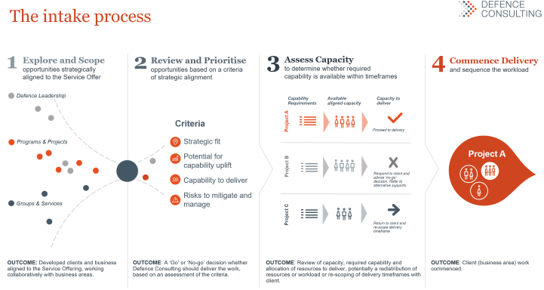
Defence Consulting in-take process visual.
Image: Defence
Various tools and methodologies are used to deliver the key services. They include bespoke, co-designed approaches specific to the Defence context and globally recognised frameworks.
Examples of projects delivered by Defence Consulting include:
- Enterprise Resource Planning (ERP) Value Chain Strategic Roadmaps (Client: Business Transformation Office, Associate Secretary Group). The ERP Business Transformation Office engaged Defence Consulting to develop transformation roadmaps for each value chain across its program. The work defined future-state visions, identified key transformation initiatives and outcomes, and established strategic measures to track progress. This provides a structured pathway to support delivery of the ERP transformation.
- Operating Model Design (Client: Strategy, Policy and International Group). Ahead of the establishment of the Australian Nuclear-Powered Submarine Safety Regulator in November 2025, Defence was required to establish an internal, associated policy function. Defence Consulting assessed the scope, scale and anticipated workload of the new function. It also developed an operating model and functional design to support its effective establishment and ongoing delivery.
Strategic Commissioning Framework
The APS Strategic Commissioning Framework (SCF) is helping agencies move from outsourcing work that is the core role of the APS.
The framework was published in October 2023. It sets the expectation that core work will be delivered by APS employees. It also outlines limited circumstances in which external workforces could be appropriate, and ensures the APS maximises the benefit of external arrangements.
The SCF applies to all agencies that employ staff under the Public Service Act 1999. Agency heads are accountable for implementation in their agency. The Australian Public Service Commission has provided guidance and support to help agencies meet their SCF implementation and reporting obligations.
Efforts to reduce outsourcing of core work
The SCF’s initial implementation period runs from 2024–25 to 2026–27, with agencies reporting for the third time in 2026.
Both the 2024 and 2025 SCF public updates provide a snapshot of the foundational work completed by agencies. This is work that reduces outsourcing of core work and embeds the SCF in the first 2 years of implementation.
In 2024, agencies set a combined target to reduce supplier expenditure by $527.6 million as they brought core work in-house. This target was slightly exceeded, with agencies collectively achieving actual reductions of $542.3 million, noting results varied across agencies. In 2025, agencies set a combined target to bring another $438.9 million of core work in-house.
In the first 2 years, targets were an important part of implementing the policy. So too were agencies’ identification of their core work and ongoing efforts to bring such work in house. Most agencies now report they no longer outsource core work and operate in line with the SCF. Recognising the progress agencies have made, SCF implementation and reporting efforts will focus on supporting agencies to bring – and keep – core work in house.
Agencies are required to continue reporting on SCF implementation in corporate plans and annual reports.
Agencies implementation progress in 2025–26
The 2026 reporting requirements are aimed at continuing to drive progress, transparency and accountability. All agencies in scope of the SCF reported on their progress through the APS Agency Survey.[1] Table 23 shows agency reporting of core work by job family for 2026–27.
Table 23: Core work by job family
| Job Family | Number of agencies |
|---|---|
| Accounting and Finance | 70 |
| Portfolio, Program and Project Management | 70 |
| Policy | 65 |
| Communications and Engagement | 63 |
| Data and Research | 62 |
| ICT and Digital | 61 |
| Legal and Parliamentary | 61 |
| Compliance and Regulation | 59 |
| Human Resources | 59 |
| Service Delivery | 55 |
| Business and Organisational Management | 52 |
| Intelligence and Information Management | 48 |
| Engineering and Technical | 18 |
| Science | 18 |
| Health | 15 |
| Trades and Labour | 9 |
All APS agencies reported taking steps to embed the SCF and build in-house capability to deliver core work. The most common steps taken by agencies to embed the SCF were:
- working with business divisions to identify the agency’s core work (75% of agencies)
- establishing and/or strengthening internal reporting processes for the SCF (62%)
- communicating expectations for hiring and procuring managers (62%)
- reviewing/updating procurement policies and forms (61%).
The most common actions taken by agencies to build in-house capability to deliver core work were:
- recruiting employees with priority skills (86% of agencies)
- investing in training and development (74%)
- upskilling staff through guidance or standard operating procedures (70%)
- supporting staff development through mobility opportunities (67%).
Agencies that set a target for 2025–26 were also asked to provide an early indication of target progress.[2] Of the 40 agencies that set a target for this financial year:
- 24 reported being on track to achieve their target
- 9 reported they were not on track
- 7 were unable to advise (for example, if the agency had not finalised internal reporting to determine if it was on track to meet its target).
Agencies that set a target for 2025–26 are required to report on achievement of targets in their annual reports.
In 2026, 8 agencies reported outsourcing core work outside the SCF’s limited circumstances, down from 15 in 2025. For at least 4 of these, outsourcing was reported to be minimal and related to just one or 2 positions within each agency.
Agencies reported they are taking action to bring this core work in-house. This includes continued upskilling of employees, reallocation of resources, supporting training and development, and recruiting priority skills. Additionally, agencies that outsourced core work outside the limited circumstances are required to include this information in annual reports.
Looking ahead to 2026–27
The expectation for agencies to continue taking steps to embed the SCF continues in 2026–27, the final year of its initial implementation period.
While agencies have made wide-ranging efforts to embed the SCF in their operations, there is more work to do. Reporting highlights areas where action from agencies has been less common. For example, fewer agencies reported taking steps to update:
- finance and procurement and human resources systems to enable reporting (48% of agencies)
- Budget processes (36%)
- project planning to consider the SCF (19%).
Another example is that fewer agencies reported taking certain actions to build in-house capability. This included:
- building knowledge transfer requirements into new contracts (41% of agencies)
- reviewing and updating workforce plans (40%)
- planning for succession (39%)
- partnering across the APS to deliver core work (21%).
Noting SCF is intended to be implemented over time, these areas may represent opportunities for agencies to focus efforts as part of ongoing implementation.
Footnotes
[1] The information gathered is based on self-reporting. The Australian Public Service Commission has not undertaken quality assurance of data provided by agencies and, as such, caution should be taken when analysing the data and drawing definitive conclusions. ↩ Return to text
[2] Figures reported are as at 9 September 2026 and reflect information agencies provided through the 2026 APS Agency Survey and in follow up engagements with the Australian Public Service Commission. ↩ Return to text
See also in this report
A capable and future ready APS, Effective and inclusive leadership, State of Service Report 2026.
A capable and future ready APS, Workforce development and learning, State of Service Report 2026.
Find out more
Australian Public Service Commission (2024) Workforce Planning Resources, APSC website, accessed 17 August 2026.
Australian Public Service Commission (2026) Capability Review Program, APSC website, accessed 16 August 2026.
Australian Public Service Commission (2026) APS Strategic Commissioning Framework, APSC website, accessed 22 September 2026.
Australian Public Service Commission (2025) Outsourcing in limited circumstances, APSC website, accessed 22 September 2026.
Australian Public Service Commission (2024) 2024 Strategic Commissioning Framework public update, APSC website, accessed 22 September 2026.
Australian Public Service Commission (2025) 2025 Strategic Commissioning Framework public update public update, APSC website, accessed 22 September 2026.
Home Affairs (2024) Home Affairs Capability Review, APSC website, accessed 16 August 2026.
Home Affairs (n.d.) Transformation on a page, Home Affairs website, accessed 16 August 2026.
National Indigenous Australians Agency (2026) Commonwealth Priority Reforms Roadmap, NIAA website accessed 18 August 2026.