



Partnership capability for impact

Partnership capability is increasingly important in the APS. This is because many challenges facing government are complex, interconnected and beyond the influence of any single agency. Issues such as climate change, natural disasters, cyber security, housing, and Closing the Gap require coordinated action across governments, sectors and communities.
As a result, public servants must be able to work effectively across organisational and jurisdictional boundaries. Strong partnership capability enables the APS to draw on diverse expertise, perspectives and resources. This leads to more innovative, responsive and citizen-centred policy, and service delivery outcomes.
Partnerships are also critical to implementation. Many government initiatives rely on collaboration with state and territory governments, service providers, industry, academia and community organisations. Success therefore depends on a range of skills, alongside traditional policy and technical expertise. Examples include stakeholder engagement, influence, negotiation, collaboration and co-design.
As the APS increasingly operates in a networked environment, partnership capability has become a core public service skill. It supports stewardship, systems thinking and cross-agency collaboration, helping ensure the APS can respond effectively to complex challenges and deliver better outcomes for the Australian community.
Working to build good work design capability – APS Academy and Comcare
The modern APS comprises agencies of varying sizes, functions and geographic locations. This creates challenges for traditional learning approaches that rely on classroom delivery and static content.
To address these challenges, the APS Academy has developed a scalable social learning model that strengthens leadership, management and APS craft capability across the service. It does so through an integrated learning ecosystem combining technology-enabled learning, practitioner-led facilitation, peer interaction, coaching, and workplace application.
Working with APS practitioners, subject matter experts, academics and cross-agency groups ensures learning is credible. It also ensures that learning is evidence informed and grounded in the realities of public administration. This approach now underpins the APS Graduate Development Program, APS Leadership Edge Program and APS Management Edge Program. Together these create connected development pathways from graduate to executive levels.
The partnership between the APS Academy, Comcare and Curtin University’s Centre for Transformative Work Design in 2025–26 demonstrates the effectiveness of this collaborative model. The 2024–25 Capability Reinvestment Fund project, Building Safety and Integrity Capability Across the APS integrated SMART work design into Leadership Edge.
The initiative provided education, case studies and practical tools to help participants identify and address work design issues. Participants explored how work design influences wellbeing, performance and innovation, and how psychosocial risks can be addressed at their source. Social learning enabled participants to test concepts in their own contexts, share challenges with peers and apply SMART work design principles in practice.
Evaluation of the Leadership Edge pilot found that the SMART work design framework improved role clarity, workload management and task allocation. Team collaboration was the most consistently reported outcome. Participants describe stronger team dynamics, more open dialogue and improved peer coaching and cross-functional communication.
The partnership combines the APS Academy’s leadership capability expertise with Comcare’s strengths in:
- work health and safety
- psychosocial risk management and return to work
- embedding good work design across APS leadership development and agency practice.
Expanding Census participation through myGov
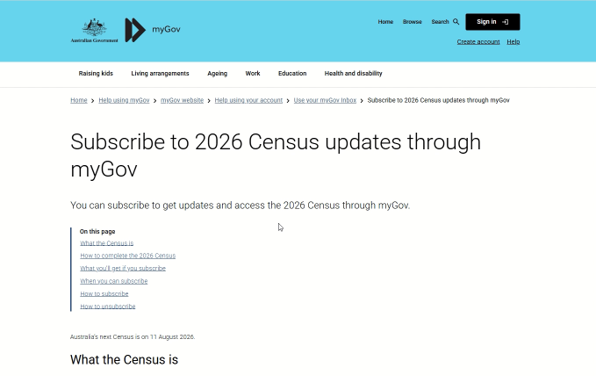
myGov website screenshot.
Image: Services Australia
The 2026 Census of Population and Housing was held on 11 August 2026. Services Australia and the Australian Bureau of Statistics (ABS) partnered from 1 July 2024 to deliver a new secure and accessible subscription option through myGov.
Many Australians already use myGov to access a range of government services and information. This new option made it easy for people to get updates and access the 2026 Census online through a trusted and familiar channel.
More than 130,000 people subscribed between 18 May and 14 June 2026 to get Census information, reminders and a secure link to their Census form through their myGov inbox.
Services Australia and the ABS built an integrated, multidisciplinary partnership. This brought together policy, business and technology expertise from both agencies. The objective was to provide a simple, helpful and transparent experience while maintaining strong security and privacy protections. Combining myGov's digital platform with the ABS's role as custodian of Census data showed how government services can work together to encourage participation and deliver people-focused outcomes.
Services Australia coordinated contributions across its product, engineering, cyber security, fraud, legal, and operations teams to design and deliver the myGov integration. This ensured the solution was secure, scalable and aligned with customer needs while meeting legislative, assurance and fraud control requirements.
The ABS, as the agency responsible for delivering the 2026 Census, provided business requirements, content and core digital service capabilities. It also led Census program governance, readiness activities and overall delivery of the Census. Communications teams from both agencies worked together to develop content and communications materials to build awareness of the new myGov option.
Joint governance forums, shared delivery plans and integrated testing meant coordinated decision-making, while regular engagement enabled the early identification of risks and dependencies. This enabled both agencies to focus on their respective strengths while operating as a single delivery team. The result was a secure, coordinated and accessible service delivered at national scale.
The integration of the 2026 Census into myGov complements existing paper and online channels. This provides Australians with another simple, accessible and familiar option to participate in this important national activity. It supports high-quality national data collection and demonstrates the value of connected people-focused digital services. It also has the potential to reduce future costs while providing a more consistent customer experience by better aligning digital services across government.
Partnership-driven reform establishes new national commission
The National Commission for Aboriginal and Torres Strait Islander Children and Young People Act 2026 came into effect on 1 July 2026, establishing a permanent, independent statutory agency. This agency protects and promotes the rights, interests, development, safety and wellbeing of Aboriginal and Torres Strait Islander children and young people and build on their strengths.
Following decades of advocacy by First Nations leaders, the Department of Social Services and the National Commission worked in partnership to establish a legislated National Commission to drive systemic reform. The partnership was grounded in mutual respect and trust, shared leadership, and a willingness to collaborate beyond traditional processes to find new ways of working.
Throughout the legislative development process, the department collaborated with the National Commission, recognising Aboriginal and Torres Strait Islander expertise and leadership as central to policy design and fundamental for lasting change. The establishment of a fully independent National Commission demonstrates systemic and structural transformation within government. It does so under Priority Reform Three of the National Agreement on Closing the Gap.
The legislation establishes a permanent National Commissioner for Aboriginal and Torres Strait Islander Children and Young People. The Commissioner’s role is to:
- identify systemic barriers through inquiries and research
- hear directly from children and young people about matters affecting their lives
- support children and young people to understand and assert their rights
- advise government on the development and delivery of policies, programs and services.
The National Commissioner promotes stronger coordination across governments to address issues that disproportionately affect Aboriginal and Torres Strait Islander children and young people. Examples include out-of-home care and youth detention.
Intentionally embedding a relational approach to developing the Bill involved collaborating with stakeholders across Commonwealth, state and territory governments and First Nations leaders. This ensured diverse perspectives were reflected in the Bill to achieve legislation that was celebrated within the community. The approach helped to build trust and transparency. It also allowed teams to respectfully contest ideas, refine and agree on policy measures that could be implemented in pursuit of the shared goal.
This outcome could not have been achieved through traditional, siloed approaches, and the legislation may not have been as strongly supported by communities had the department acted alone. Working in partnership with multiple levels of government, Aboriginal leadership and key non-government stakeholders delivered a transformative piece of legislation reflecting the innovative and collaborative approach taken. It provides a model of best practice for working with non-government and First Nations partners. It also illustrates how working across institutional and historical boundaries can translate long-standing aspirations into enduring outcomes.
See also in this report
Protecting the nation and the region, Protecting Australians through integrated crisis management, State of Service Report 2026.
Supporting Australia’s economic future, Innovation through business and industry partnerships, State of Service Report 2026.
Serving the Community, Community engagement shapes the future of the Murray-Darling Basin, State of Service Report 2026.
Working in the APS, Driving innovation and productivity, State of Service Report 2026.
Find out more
Centre for Transformative Work Design (2026) SMART work design framework, Centre for Transformative Work Design website, accessed 1 September 2026.
Comcare (2026) Work design, Comcare website, accessed 25 September 2026.
Federal Register of Legislation (2026) National Commission for Aboriginal and Torres Strait Islander Children and Young People Act 2026, Federal Register of Legislation website, accessed 11 September 2026.
National Commissioner for Aboriginal and Torres Strait Islander Children and Young People (2026) Youth Justice (Circuit Breaker) Amendment Bill 2026, NCATSICYP website, accessed 11 September 2026.