



Accelerating global collaboration on monitoring and protecting coral reefs
Project summary
Coral reefs occupy only 1% of the ocean floor, but are home to more than a quarter of all marine life. More than half a billion people depend on them for food, income and protection. These reefs face increasing threats from climate change, overfishing and pollution, and it is predicted that 90% of them will be critically endangered by 2050 if action is not taken now.
Globally, scientists monitor coral reefs by analysing images of these ecosystems to inform how to manage and protect them. This resource and labour-intensive process means informed actions are delayed.
ReefCloud is an AI model that brings together monitoring efforts from around the world. The model and its applications were developed by the Australian Institute of Marine Science. The project was co-funded by the institute and Foreign Affairs and Trade.
ReefCloud provides a user-friendly platform that makes technology accessible. This supports the delivery of actionable data from monitoring to management. The platform analyses coral reef composition with 80 to 90% accuracy, 700 times faster than traditional manual approaches.
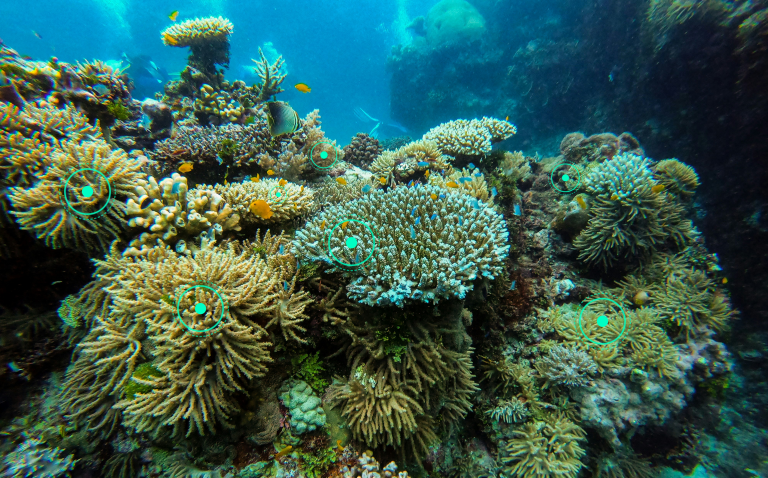
Typical landscape reef communities in the Great Barrier Reef Marine Park, with circles highlighting areas AI algorithms in ReefCloud use to identify the corals.
Image: Australian Institute of Marine Science
How AI contributes to the project
ReefCloud harnesses the power of AI and advanced statistical models in a human-centred design to accelerate the delivery of science for coral reef management. It automates data processing and analysis of coral reef images using Convolutional Neural Networks, a computer vision AI framework for image recognition.
The AI model uses training data from over 20 years of monitoring across the Great Barrier Reef Marine Park to identify key features of corals and their associated organisms. This knowledge serves as foundational training to assist others around the world to apply and customise the AI model to quickly identify features from their own coral reefs.
When users submit photos of the reefs taken during their surveys, ReefCloud uses facial recognition technology to identify around 7 million parameters from the colour, shape and size of coral. The model can then identify the type of coral and analyse how the reef is changing over time.
Working with Accenture on design research, prototyping and testing, AIMS overcame the challenge of presenting complex data in a way that makes sense to a range of users. ReefCloud users include scientists, managers, policymakers, local communities and members of the general public.
The platform’s user-friendly interface has made coral reef monitoring more accessible to a broader audience, including Traditional Owner rangers, tourism operators, local communities and scientists. This fosters greater engagement and collaboration in conservation efforts.
ReefCloud was co-designed with Pacific Island nations so AI technologies could be applied beyond Australia and support Pacific efforts in coral reef conservation. The work enables the global reef community to observe changes in near real-time and determine the most effective actions needed.
Outcomes and next steps
The ReefCloud platform features over 4.5 million survey images from more than 2,900 users in 100 countries and territories worldwide. This level of demand demonstrates the global community's interest in accessing an innovative and effective management tool.
ReefCloud tackles coral reef monitoring challenges by alleviating resource limitations, increasing efficiency, preventing inconsistencies, producing timely reports and integrating monitoring efforts.
Results from the 2024 user online survey showed that 84% of respondents stated that ReefCloud had improved their ability to process and analyse benthic data. A total of 72% of respondents reported that ReefCloud was highly or moderately useful to their work.
ReefCloud continues to improve capabilities in coral reef monitoring, particularly in the Pacific and South East Asia regions, and support knowledge-sharing to empower decision-makers in managing coral reefs.
Find out more
Sing Wong A, Vrontos S, & Taylor M L (2022) An assessment of people living by coral reefs over space and time, Global Change Biology, 28(23):7139-7153.
Hoegh-Guldberg O, Jacob D, Taylor M, Bindi M, Brown S, Camilloni I, Diedhiou A, Djalante R, Ebi K L, Engelbrecht F, Guiot J, Hijioka Y, Mehrotra S, Payne A, Seneviratne S I, Thomas A, Warren R, & Zhou G (2018) Impacts of 1.5ºC global warming on natural and human systems, Intergovernmental panel on climate change website, accessed 20 August 2025.
Australian Institute of Marine Science (2025) ReefCloud, AIMS website, accessed 31 July 2025.