



Public trust in the APS

Public trust is essential to a healthy democracy and to an effective APS. People need confidence that government institutions act with integrity, use public resources responsibly and make decisions in the public interest. Trust also shapes whether people engage with government, use public services and act on information and advice.
Trust is built through everyday experiences. Every interaction with government can influence how Australians view public institutions, from accessing a service to receiving information or understanding a policy decision. Clear, timely and accessible communication helps people understand what is happening, what is expected of them and where they can find support. It reduces confusion and gives people confidence that government is listening and responding to their needs.
Measuring trust and satisfaction gives Australians a voice in assessing how government is performing. It also helps the APS understand where confidence is strong, where it is changing and where more work is needed. Surveys such as the OECD Trust Survey provide insights into how people experience public institutions and how they view government’s ability to respond to complex challenges (OECD, 2025b; 2026).
The APS uses this evidence to strengthen the way it communicates and delivers services. Building trust is not a one-off task. It requires consistent action, transparency and a focus on people’s experiences. By listening to Australians, communicating clearly and acting with integrity, the APS can strengthen confidence in public institutions and support a democracy that works effectively for everyone.
Measuring satisfaction with democracy
Public satisfaction with democracy provides an important indicator of how Australians perceive the performance and legitimacy of democratic institutions and processes. Satisfaction is also an important indicator of the extent to which these institutions are meeting community expectations.
Australians engage with democracy through formal processes, such as elections, and through everyday interactions with government, public services, and their communities. These experiences influence how Australians assess the performance of democratic institutions and processes, and their views on opportunities for improvement.
Results from June 2026 indicate that a majority of Australians (55.1%) were satisfied with democracy.
Satisfaction with democracy varied across different groups of Australians. People aged 18 to 34 years reported the highest level of satisfaction (61.9%), followed by those aged 65 years and over (56.0%) and people aged 35 to 64 years (50.6%). Men were more likely to report being satisfied with democracy (61.4%) than women (49.2%). Satisfaction was higher among people living in metropolitan areas (58.8%) compared with those living in regional areas (44.7%).
These findings highlight that experiences and perceptions of democracy differ across the community. They underscore the importance of designing policies and services that reflect the diverse needs, expectations and experiences of Australians. By ensuring public services are accessible, responsive and inclusive, governments can help strengthen confidence in democratic institutions and support positive civic outcomes.
Trust and satisfaction in Australian public services
Trust is shaped by people's experiences of public services. Services that are accessible, reliable, and responsive help build confidence that government can deliver on its commitments and meet community expectations. Australians have more trust in public services when they have positive personal experiences with public servants and services. Faster services, easier-to-use online services and greater transparency also lead to more trust in those services. People who used the services for the first time and found them better than expected also reported higher levels of trust.
The Trust in Australian public services: 2026 Annual Report was released by the Australian Public Service Commission (APSC) in October 2026. The report captured community feedback from more than 1,000 people surveyed monthly on trust and satisfaction with Australian public services in the period July 2025 to June 2026.
Measuring trust and satisfaction in public services is important. It allows the public to have a voice in evaluating the effectiveness of services and helps prioritise areas most in need of improvement.
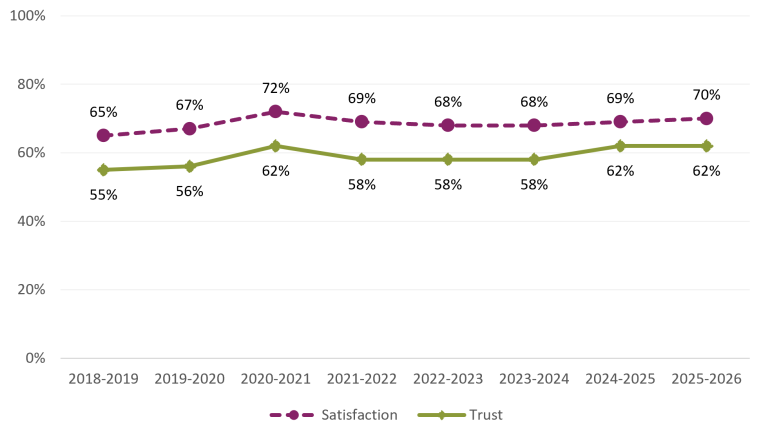
In 2025–26, trust in Australian public services remained at its historical high of 62%, the same level it was in 2024–25 and equal to its peak in 2020–21 (Figure 7).
Satisfaction with Australian public services increased to 70% in 2025–26, one percentage point higher than in 2024–25.
Figure 7: Trust and satisfaction with Australian public services (2018–19 to 2025–26)
While the overall level of trust in Australian public services has increased, gaps between groups remain:
- men (66%) display greater trust in public services than women (58%)
- trust is higher for those aged 18 to 34 years (68%) than those aged 35 to 64 (58%) and 65 and over (62%)
- those living in metro areas are more trusting than people who live in regional areas (65% and 56% respectively).
When asked why their trust had increased, respondents most often talked about:
- positive personal experiences, based on interactions with APS employees who were helpful, respectful, and resolved their issues
- services that were faster, easier to use online, and more transparent
- accessing a service for the first time and finding it better than expected.
Organisation for Economic Co-operation and Development Trust Survey
Trust in the Australian Government is rising and above the Organisation for Economic Co-operation and Development (OECD) average.
According to the most recent OECD Trust Survey (OECD, 2026), high or moderately high trust in the Australian Government grew from 38% in 2021 to 46% in 2023. It reached 51% in 2025 compared to the OECD average of 40%.
Australia also scores above the OECD average on:
- trust in public institutions across armed forces, law-and-order institutions (such as the police and judiciary), public services, news media, and political parties
- perceptions of day-to-day dealings with public institutions, with better results across 13 service interaction indicators compared to the OECD average, including how easy it was for people to access services, get information, and have issues resolved
- decision-making on complex policy issues, with better results on 14 out of 15 indicators related to complex government decision-making, particularly confidence in government providing adequate support in an economic crisis and being ready to protect lives in an emergency
- artificial intelligence (AI) use in government indicators, with Australia scoring higher on 5 dimensions of confidence in potential AI use by government: to reduce costs; maintain human oversight; ensure fairness; ensure transparent AI use; and protect information.
The OECD Trust Survey explores people’s perceptions of different public institutions in their country and the degree to which they trust their government. These perceptions range from day-to-day interactions with public institutions to decision-making on complex policy issues. The survey showcases evidence of people’s experiences with and expectations of government reliability, responsiveness, fairness, integrity, and openness.
The 2025 survey, which followed earlier rounds in 2021 and 2023, includes 33 OECD countries and 5 OECD accession countries. It covers a representative sample of the adult population of each participating country. Carried out between 10 September and 5 November in Australia, the survey aligned with data collection in most participating countries.
Building public trust through clear government communication
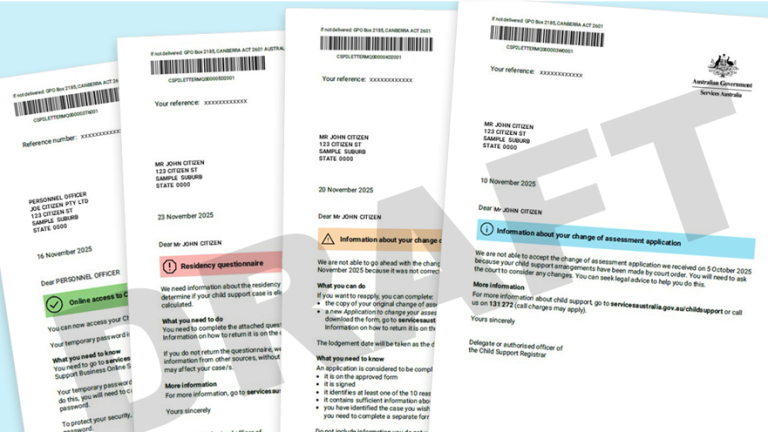
Examples of Services Australia letters and forms.
Image: Services Australia
Clear communication helps Australians understand what government is asking them to do. It reduces confusion, improves service delivery and strengthens trust. That trust is essential for an effective public service, particularly when people need to make important decisions or access government services.
The Correspondence Design and Delivery team at Services Australia works with APS agencies to improve the design of letters and forms. Drawing on experience managing high volumes of government correspondence, the team shares practical methods, templates and advice. This helps agencies produce clear, consistent and easy-to-use communications.
In 2025–26, the team partnered with the Aged Care Quality and Safety Commission to strengthen its approach to correspondence. Working closely with commission staff, the team reviewed existing letters, simplified language and structure, and developed clearer templates and governance arrangements. The result is a more consistent approach to communicating with older Australians and aged care providers in complex and often sensitive situations.
The team also worked with the Australian Passport Office to share practical approaches to forms design. Through workshops and discussions, both agencies exchanged ideas on standards, usability, accessibility and consistent design. The partnership enabled both organisations to learn from each other's experience and improve their own practices.
The focus was not on delivering one-off products but on improving efficiency and effectiveness. By establishing reusable templates, practical guidance and stronger processes, the work will continue to support better communication.
Australians benefit when government communication is easier to read and understand. Clear letters help people know what they need to do and reduce the need for follow-up enquiries. Well-designed forms make it easier to provide accurate information, reducing errors and delays.
By sharing practical knowledge across agencies, the APS is creating a more consistent experience for Australians accessing government services. Clear, reliable communication helps members of the public understand what they need to do. It also supports better service delivery and strengthens public trust in government.
See also in this report
A trusted and accountable APS, A culture of integrity and stewardship, State of Service Report 2026.
A trusted and accountable APS, Guardrails and protections, State of Service Report 2026.
Serving the community, Making tax and superannuation systems more accessible for people experiencing vulnerability, State of Service Report 2026.
Find out more
Australian Public Service Commission (2024) Trust and Satisfaction in Australian Democracy survey report, APSC website, accessed 4 August 2026.
Australian Public Service Commission (2026) Satisfaction with Australian Democracy – Pulse reports, APSC website, accessed 4 August 2026.
Australian Public Service Commission (2026) Trust in Australian public services: 2026 Annual Report, APSC website, accessed 30 October 2026.
Organisation for Economic Co-operation and Development (2026) OECD Survey on Drivers of Trust in Public Institutions 2026 Results: Australia, OECD website, accessed 31 July 2026.