



A culture of integrity and stewardship

Integrity is vital to democracy and effective public administration. Nurturing organisational cultures that centre values, ethics and stewardship to care for what is entrusted to the APS by government and the Australian community is a core priority.
The Public Service Act 1999 sets the expectations for public servants’ actions and behaviour through the APS Values, APS Employment Principles, and the Code of Conduct. Culture, however, lays the foundations for ethical behaviour.
A culture of integrity requires more than a compliance-driven approach focused exclusively on the avoidance of wrongdoing. In the APS, acting with integrity means doing the right thing. This means being transparent and accountable, upholding high standards of professionalism, and ensuring that actions and decisions are fair, lawful, honest and impartial. In 2026, 79% of APS Employee Census respondents indicated that the culture in their agency supported people to act with integrity.
A positive integrity culture is one where leaders and employees work together to foster psychologically safe workplaces that encourage collaboration, discussion and speaking up about integrity issues. In these cultures, reporting integrity concerns is encouraged and taken seriously. Failings, such as bullying and harassment, are called out, acknowledged and proactively addressed.
In 2026, the APS Employee Census introduced a Speak Up Culture Index. This validated and evidence-based measure assesses the extent to which employees believe they can ask questions or speak about ideas, concerns, and mistakes within their workplace. The overall index score was 74 (out of 100), with most Census respondents indicating that their workgroup:
- was comfortable checking when they had questions about the right way to do things (88%)
- valued others’ individual skills and talents (82%).
A slightly lower proportion felt people in their workgroup could bring up problems and tough issues (79%).
Fundamental to a culture of integrity are responsive leaders. These are leaders who respond to integrity concerns and foster psychologically safe environments where every worker can play their part in caring for and nurturing group culture. This shared commitment to upholding integrity is key. It ensures that as stewards of public resources, public trust and the national interest, public servants continue to deliver for Australians to the highest standards of professionalism.
Maturing regulatory and cost recovery for vocational education and training
Stewardship and public value underpin the Australian Skills Quality Authority’s (ASQA) approach to strengthening regulation of Australia’s vocational education and training sector. ASQA has introduced an updated regulatory approach and cost-recovery model to support more transparent, efficient and risk-based regulation.
ASQA redesigned its regulatory activities to make them simpler, more consistent and better targeted, while supporting government priorities and the broader productivity agenda. Provider feedback informed the reforms, particularly calls for greater transparency about regulatory processes and costs.
Policy, regulation, finance, legal, communications, technology and corporate teams worked together to design and implement the new model. ASQA also worked with Employment and Workplace Relations, Finance, and state and territory governments. A hybrid model brought together workstream leads, change champions and operational readiness activities, to create shared ownership of risks, clear responsibilities and consistent communication.
The project team demonstrated the APS Secretaries Charter of Leadership Behaviours by:
- Being dynamic – deploying resources in new ways to deliver complex outcomes within a compressed timeframe.
- Being respectful – consulting through multiple channels, so more than 3,800 regulated providers had opportunities to comment on proposed changes.
- Having integrity – working transparently with stakeholders to support robust and fair decisions.
- Valuing others – drawing on diverse perspectives and experience across the internal project team.
- Empowering others – giving registered training organisations clear information to meet their obligations, engage positively with the regulator and continuously improve.
These reforms strengthen stewardship of public resources. Clearer activities and charging arrangements reduce ambiguity, improve accountability and provide better information to monitor regulatory performance. Together, reforms reinforce APS Values through integrity, transparency, collaboration and long-term stewardship. They do so while supporting better outcomes for around 5 million vocational education and training students each year.
Creating a safer NDIS through provider registration reforms

A NDIS provider assisting a participant using a laptop.
Image: NDIS Commission
The NDIS Quality and Safeguards Commission continues to reform how it registers providers. This is to better protect participants, strengthen regulation and support the long-term sustainability of the NDIS.
Currently, 92% of NDIS providers are unregistered. Recent reforms, including mandatory registration for Supported Independent Living and NDIS Digital Platform providers, are increasing the number of registered providers and improving oversight across the sector.
Reforms have delivered significant improvements. Since 2024, the commission has reduced outstanding registration applications by 82% and cut application processing times by 78%. It has also introduced a purpose-based assessment model, streamlined systems and increased the use of registration conditions to better manage provider risks. These improvements allow staff to focus more resources on monitoring providers and protecting participants.
Ensuring quality, safety and integrity of the NDIS is critical. It protects the rights of participants and gives all Australians confidence in the integrity and long-term sustainability of the scheme.
The NDIS Quality and Safeguards Commission works closely with many agencies. This includes:
- the National Disability Insurance Agency
- Services Australia
- the Australian Federal Police
- the Australian Criminal Intelligence Commission
- states and territories
- other regulators, such as the Aged Care Quality and Safety Commission.
Through initiatives such as the Fraud Fusion Taskforce, agencies share intelligence and evidence to detect fraud, strengthen compliance and protect the integrity of the scheme.
Fraud Fusion Taskforce
The Fraud Fusion Taskforce was established as a direct response to the growing threat of opportunists and criminals exploiting system weaknesses across the NDIS and other government payment programs.
The taskforce brings together 25 government agencies. These work to identify, investigate and prevent fraud and serious organised crime in the NDIS, other government payment programs and services such as Medicare or Child Care Subsidy.
Agencies include:
- departments such as Attorney-General’s and Health, Disability and Ageing
- independent regulators and oversight bodies, such as Fair Work Ombudsman, Aged Care Quality and Safety Commission; NDIS Quality and Safeguards Commission and Australian Charities and Not-for-profits Commission
- law enforcement and Intelligence bodies, such as the Australian Criminal Intelligence Commission, Australian Federal Police, and Commonwealth Director of Public Prosecutions.
The taskforce works to strengthen fraud detection and payment integrity. It does so by improving the ability to detect and disrupt fraud, serious and organised crime and other high-risk entities targeting the NDIS and other government programs. These measures help ensure services and payments reach those who are eligible.
The National Disability Insurance Agency (NDIA) and the Fraud Fusion Taskforce are delivering strong outcomes. Collectively, integrity initiatives delivered for the NDIS by June 2026 are estimated to deliver more than $4.1 billion in benefits between 1 November 2022 and 30 June 2029. Of these benefits, $1.2 billion in prevented non-compliant payments and $0.9 billion in redirected payments was already realised by 30 June 2026. Benefits are expected to increase as future interventions are implemented.
Prosecutions contributing to jail sentences in 17 of the 26 NDIS-related criminal convictions have been secured since December 2022. Other offenders received intensive correction orders, fines and orders to repay stolen funds.
More than 5,900 high-risk NDIS providers identified as responsible for incorrect or non-compliant claims have been disrupted. These providers had claimed around $1.1 billion in the 12 months before intervention and more than $6.5 billion since the start of the NDIS.
Fraud Fusion Taskforce insights have also informed system uplifts and technology design including NDIA’s Crack Down on Fraud program. This program is strengthening NDIA's ability to combat fraud while improving the experience for NDIS participants and providers, making it easier to submit legitimate claims. Key initiatives delivered include:
- a new integrity management system
- strengthened identity authentication for participants and providers
- A new NDIS mobile app and online systems that enhance user experience while strengthening security protections.
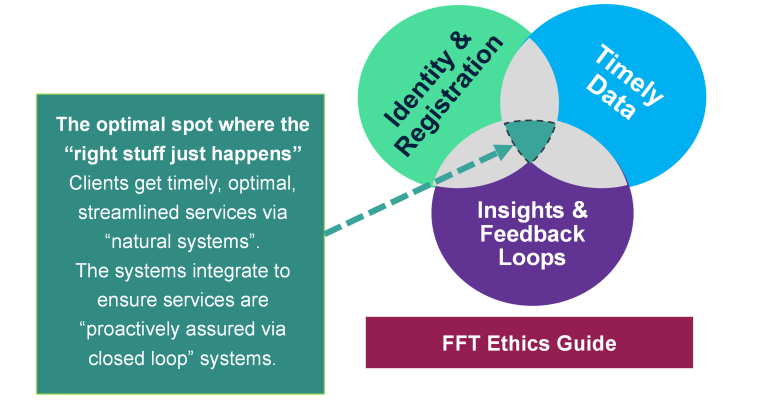
Optimising the Ecosystem. A gentler world where “the right stuff just happens”.
Image: National Disability Insurance Agency
Whole-of-government strategic prevention
The Taskforce has developed Strategic Prevention Concepts that agencies can adopt to strengthen integrity across government systems.
Seven building blocks that government payment programs should embed to improve integrity have been identified by the taskforce:
- identity is not optional
- real-time suitability is needed
- verify by default; trust by exception
- share data to close loops
- make supply chains transparent
- deploy multiple layers of defence
- vigilance is necessary to contain exposure.
The taskforce has demonstrated the extraordinary strategic and operational benefits and speed of innovation that can be realised when the full breadth of APS talent and experience focuses on tackling and resolving complex challenges.
National Library of Australia Trove Metadata Manager Project

The National Library's Trove Metadata Manager Project won the Data Leadership and Capability Building category at the APS Data Awards (March 2026).
Image: National Library of Australia
The National Library of Australia’s Trove Metadata Manager project has modernised the national infrastructure used to deliver Trove. Trove is a single point to a national collection of artefacts and stories from Australia's history and culture. It connects digital collections from contributing organisations, known as partners, from across Australia. This includes libraries, museums, galleries, community and government. Behind the scenes, the Trove Metadata Manager aggregates a rich data source describing millions of collection items, making discovery journeys possible.
The project has transformed how Australia's cultural sector manages and shares collection information. It has introduced a format-agnostic, linked data platform for the Australian National Bibliographic Database – Australia's largest bibliographic resource. In doing so, the project has laid a foundation for richer, more connected collection discovery through Trove. The result is greater visibility of collections and improved access for contributing organisations and the Australian public.
Around 900 organisations across the country now use the Trove Metadata Manager to describe, enrich and share their collections. The platform is strengthened by integration with the Australian Institute of Aboriginal and Torres Strait Islander Studies thesauri in Trove partner search. It also enhances access and discovery of significant cultural materials, including First Nations collections.
The Trove Metadata Manager Project has demonstrated strong stewardship by ensuring Australia’s cultural collections are managed responsibly and remain accessible to the public. Working collaboratively with collecting organisations, the National Library created a trusted national platform that supports transparent data sharing while preserving connections to source collections. This approach strengthens confidence in Australia’s cultural record and ensures it can continue to deliver value for future generations.
Built on the Bibliographic Framework standard, the platform replaces a traditional flat data structure with a linked data framework. It positions Australia's cultural data for future innovation and interoperability. It also supports richer connections between collections and represents the first implementation of this scale and complexity for an English-language data store.
Strong records, Strong APS
The Strong Records, Strong APS campaign was developed by the Australian Public Service Commission (APSC) in consultation with the National Archives of Australia and Office of the Australian Information Commissioner. The campaign was part of a series responding to Recommendation 9 of the Louder Than Words: An APS Integrity Action Plan. This plan calls for reinforcing the importance of good record keeping for integrity and supporting its practice across the APS.
Promoted from January to August 2026, the Strong Records, Strong APS campaign strengthened awareness of good recordkeeping culture. It did so by promoting good records management and making it clear, practical and relevant to everyday work.
Good records and data management support integrity, transparency and stewardship. They help agencies make informed decisions, maintain accountability and preserve important information for current and future generations. Every APS employee plays a role in creating, managing and protecting records.
The campaign provided agencies with practical tools and resources to help staff understand the value of good recordkeeping and apply it in their daily work. It used a multi-channel approach to reach audiences through social media, the APSC website, and internal communication in agencies through APS communications teams and leaders. The campaign was championed by Chief Operating Officers and record management professionals. It was backed by learning opportunities available across the APS focusing on record keeping basics, privacy awareness, freedom of information and data management.
By working together, the APS continues to strengthen its recordkeeping practices, protect valuable information and deliver services with integrity.
See also in this report
A capable and future ready APS, Effective and inclusive leadership, State of Service Report 2026.
Agency Benchmarking, Supporting integrity, State of Service Report 2026.
Agency Benchmarking, Perceptions of immediate supervisors, State of Service Report 2026.
Agency Benchmarking, Perceptions of SES Leaders, State of Service Report 2026.
Appendix 2, State of the Service additional data, State of Service Report 2026.
A trusted and accountable APS, National Anti-Corruption Commission, State of the Service Report 2026.
Find out more
Australian Public Service Academy (2026) APS Foundations: Records Management, APS Academy website, accessed 7 August 2026.
Australian Public Service Academy (2026) Records System Basics, APS Academy website, accessed 7 August 2026.
Australian Public Service Academy (2026) APS Foundations: Privacy Awareness, APS Academy website, accessed 7 August 2026.
Australian Skills Quality Authority (2026) ASQA, ASQA website, accessed 8 August 2026.
National Disability Insurance Scheme Quality and Safeguards Commission (2025) Mandatory registration for Supported Independent Living and platform providers to start from next year, NDIS Commission website, accessed 6 August 2026.
National Disability Insurance Scheme Quality and Safeguards Commission (2026) Our regulatory priorities, NDIS Commission website, accessed 6 August 2026.
National Disability Insurance Scheme Quality and Safeguards Commission (2026) Digital transformation, NDIS Commission website, accessed 6 August 2026.
National Library of Australia (n.d.) Trove, NLA website, accessed 23 August 2026.