



Innovations in data and digital capability

Australia’s investment in data and digital capability is helping the APS deliver better services and solve complex problems. This sustained investment has helped Australia rank second among the Organisation for Economic Co-operation and Development countries for digital government.[5]
Strategic frameworks and governance arrangements help maintain data and digital capabilities and embed them across the service. Frameworks also support agencies to share approaches and apply consistent standards.
The impact of this is increasingly visible in how agencies use data and digital tools to improve outcomes. Examples across the APS show how new capabilities are being translated into practical solutions, from improving services and decision-making to supporting more effective policy and program delivery.
The APS can better harness the data assets it holds to deliver public benefit and solve problems. This includes making better use of data across agencies, strengthening the skills needed to work with data and ensuring data is accessible, trusted and used responsibly.
AI CoLab Alliance

AI CoLab staff during a practical AI for policy people workshop.
Image: Finance
The Artificial Intelligence CoLab Alliance (AI CoLab) shows how agencies can test AI safely, learn together and explore reusable approaches before broader implementation. This shared environment supports practical experimentation, comparison of methods and exchange of lessons across agencies. It reflects the APS AI Plan’s emphasis on common tools, shared capability and responsible scaling, while recognising that wider adoption depends on evidence, assurance and agency context.
The AI CoLab provides APS, community, industry, and academia a practical ‘third space’. This space is used to build AI literacy, confidence, and judgement through hands-on experimentation and peer learning in a low-stakes, creatively open environment. It helps participants move beyond abstract AI principles by testing and learning about tools, surfacing risks and opportunities, and discussing broader impacts and ethics. Participants can also share what responsible and effective use of AI looks like in real-world contexts.
The AI CoLab has over 2,000 subscribers. In 2025–26 it ran 86 events, with more than 800 check-ins from participants from across government (more than 50 agencies), academia, industry, and community. Attendance included more than 200 staff at the CoLab’s flagship recurring workshops: Practical AI for Policy People; and Making Information Work for Everyone with NotebookLM.
Bringing together participants across sectors and disciplines supports mutual capability uplift. It also helps the APS understand the multifaceted issues and opportunities created by generative AI, supporting more responsive, adaptive, and community-informed policy development.
The open, collaborative, and tangible approach to AI learning and adoption exemplified by the AI CoLab inspires experimentation. It also motivates participants to take learnings back into their work context to deploy AI tools responsibly and effectively.
Many staff have reported that the AI CoLab has motivated and equipped them to pursue responsible and effective AI adoption:
I didn’t realise I could do all this until AI CoLab gave me the confidence, the skills and the network. — Risk Officer, Finance
The AI CoLab has been a genuinely refreshing space for me to explore AI in a way that feels both psychologically safe and creatively open. — AI CoLab participant from the ACT Government
AI CoLab is delivered through open workshops, working sessions, talks and showcases, and working in small groups called pods, to rapidly iterate and prototype using AI. Activities are primarily run in person at the Canberra Innovation Network.
The AI CoLab was supported through the APS Capability Reinvestment Fund 2024–25. The fund supports it to facilitate co-designing and testing of safe and responsible AI tools to support integrated and inclusive policy across the APS.
Using artificial intelligence tools to support government evaluation in the Australian Government
Evaluation is a critical input to evidence-informed policy. It helps government understand what works, why and for whom, supporting more effective, efficient and equitable policies. Used safely and ethically, artificial intelligence (AI) tools can support work across the government’s evaluation process from planning and delivery to reporting findings and ensuring evidence is used.
The Australian Centre for Evaluation (ACE), in The Treasury, released an e-learning suite in October 2025. The suite provided practical tips and examples of how AI tools can support individual evaluation tasks. Combined with guidance on the ACE website, the suite provides strong foundations for building evaluation capability across the public service.
The suite was developed through a partnership between the ACE, AI CoLab, Australian Public Service Commission, Australian Bureau of Statistics, Digital Transformation Agency, and Services Australia. Its video format was informed by a rapid, mixed-methods evaluation, which included a randomised trial. The evaluation found that short videos are an effective format for delivering online training to Australian public servants.
Resources were shaped through extensive cross-agency consultation. Bringing together AI and evaluation experts and future users to critique and enhance the content helped ensure the suite was useful and fit-for-purpose.
Evaluation Profession members took part in an online AI Challenge, using AI tools to present findings from selected, published evaluation reports in different impactful ways. Members demonstrated the potential of AI tools to tailor findings for various audiences through format, language and level of detail.
Networking events gave members opportunities to:
- share learnings from the AI Challenge
- develop practical tips and examples for translating evaluation findings into formats such as podcasts
- discuss cultural competency considerations when using AI
- exchange innovative approaches from across agencies.
The Evaluation Profession, which brings together almost 8,000 members from across government continues to build on this initiative by championing different ways AI can support evaluation.
IP Australia First Response

IP First Response campaign material.
Image: IP Australia
IP First Response is an experimental digital service that helps Australian small businesses, creators and innovators understand their options when they face intellectual property (IP) protection or enforcement issues. It extends IP Australia’s traditional role of administering IP rights. The service achieves this by providing free, plain English guidance, practical pathways and digital tools at a point when users may be uncertain about what to do next.
The service combines human-centred design and multidisciplinary expertise across policy, legal, customer experience, content, communications, digital and technology. It includes structured guidance, a navigation tool and a generative artificial intelligence (AI) chatbot that helps users find government information.
IP First Response content is structured for both people and AI systems. It is helping trusted government information remain accessible and discoverable as Australians increasingly use search, self-service and AI tools to find information.
IP Australia worked with Australian Government partners, including the Attorney-General’s Department, to align copyright information with broader government guidance. Universities and external experts helped extend the service beyond IP Australia’s traditional remit. This included Swinburne University’s foundational Infringement 101 content and expert contributions from academics and practitioners. Patent and trademark attorneys, industry representatives, small businesses and innovators also contributed through discovery, testing and refinement.
IP Australia launched a minimum viable product early. It then used customer research, analytics and feedback to test assumptions and improve the service through real-world use. This approach allows the agency to trial AI-enabled capabilities while managing delivery risk and maintaining appropriate governance and confidence in the information provided.
By providing accessible, guidance and AI-assisted navigation, IP First Response lowers barriers to understanding a complex legal and regulatory environment. It helps Australians identify appropriate pathways, make more informed decisions earlier and engage professional advice more effectively when needed.
The service is also generating capability beyond the immediate product. As a testbed for AI-enabled service delivery, IP First Response is helping IP Australia in multiple ways. This includes developing expertise in AI-assisted customer support, developing AI-ready content, discoverability through large language models and AI-assisted content maintenance. These lessons can inform how the APS designs and maintains trusted digital services as customer behaviour and technology continue to change.
Innovative approaches to data in the Australian Antarctic Data Centre
The Australian Antarctic Data Centre (AADC) is pioneering new technologies to enhance data collection in Antarctica. Key innovations include advanced sensor kits on drones and helicopters, upgraded ground control systems for satellite accuracy, and machine-learning tools for metadata creation.
These advancements help support safe and effective operations within Antarctica and the Southern Ocean. By providing highly accurate maps, the AADC directly contributes to the safety of aviation, shipping, and scientific field activities.
Globally, improved data accuracy supports critical earth observation products. Information managed by the AADC feeds into major international research efforts, such as the Intergovernmental Panel on Climate Change. Map products developed by the AADC have also been used to support the extension of the Heard Island and Macdonald Islands Marine Reserve.

Australian Antarctic Division expeditioners undertaking drone flights at Atlas Cove, Heard Island (Voyage 1, 2025) – staff members Natalie Williams (right) and Melissa Fedrigo.
Image: Australian Antarctic Division
The AADC deploys these capabilities through cutting-edge platforms, including the icebreaker RSV Nuyina. They also integrate new laser scanning devices at stations and are expanding the data collection capabilities of the Australian Antarctic Division’s helicopters and fixed-wing aircraft.
To share this vast amount of information, the AADC relies on advanced cloud services capable of handling terabyte-scale data. Users can readily access this information via online data notebooks and freely available web services. During the past year, nearly 44 million data objects were accessed by Australian users, demonstrating the massive scale and reliability of this delivery system.
The AADC fulfils Australia’s Antarctic Treaty obligations by ensuring scientific data remains accessible and usable. It is recognised globally as a certified trustworthy data repository under the international CoreTrustSeal program.
Unlocking data to inform homelessness services for children
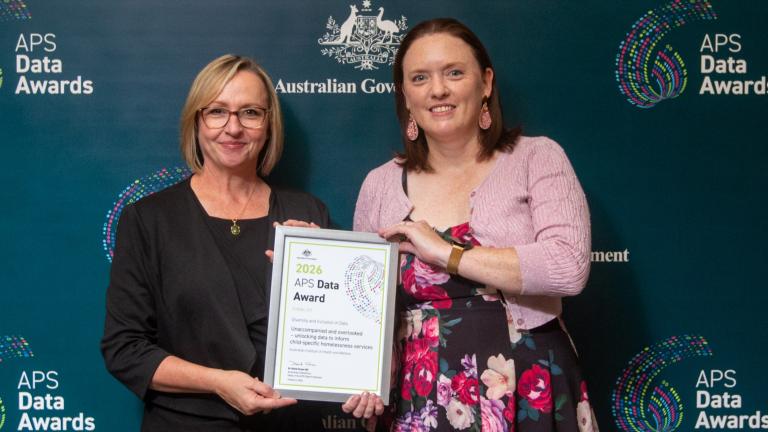
2026 APS Data Awards, Diversity and Inclusion in Data category.
Image: Australian Institute of Health and Welfare
National data did not previously identify how many children aged 12 to 17 years accessed specialist homelessness services without a parent or guardian. The Unaccompanied Children Project addressed that gap, finding that around 13,300 unaccompanied children received homelessness support in 2023–24. The Australian Institute of Health and Welfare has since embedded the analysis approach into routine annual reporting. In 2025–26, just over 11,300 unaccompanied children received support.
The Unaccompanied Children Project shows how stronger data capability can translate into better public outcomes. Unaccompanied children were often grouped with young adults or excluded from routine reporting. This made it difficult for policymakers and service providers to understand the scale of need or whether services were meeting children’s specific needs. The new approach makes this group of children visible in national reporting and supports more targeted policies and services.
The Australian Institute of Health and Welfare worked with academics, advocates and state and territory data partners to identify the reporting gap and co-design a solution. This team of partners developed a robust and repeatable method to identify children aged 12 to 17 years who presented to homelessness services alone or with other children. The method was applied across multiple years of data, validated and clearly documented.
Importantly, the approach uses existing administrative data rather than requiring new data collection or additional funding. It was first used in a national report titled Unaccompanied children receiving specialist homelessness services. Now, the method is now embedded in routine reporting in the specialist homelessness services annual report, allowing the cohort to be tracked over time.
This work demonstrates how APS data capability can turn existing data into practical evidence for better decision-making. By making previously hidden groups visible, it strengthens the evidence base for policy and service design. It also helps ensure children experiencing homelessness are counted and supported according to their needs.
See also in this report
A capable and future ready APS, Expanding census participation through myGov, State of Service Report 2026.
AI and digital innovation, Delivering better services through data-driven decisions, State of Service Report 2026.
Supporting Australia’s economic future, Illuminating Australia’s invisible industries, State of Service Report 2026.
Find out more
AI CoLab Alliance (n.d.) About the AI CoLab Alliance, AI CoLab Alliance website, accessed 12 August 2026.
Australian Antarctic Division (n.d.) Australian Antarctic Program, DCCEEW website, accessed 13 August 2026.
Australian Institute of Health and Welfare (2025) Unaccompanied children receiving specialist homelessness services, AIHW website, accessed 13 August 2026.
IP Australia (n.d.) Dealing with an Intellectual Property issue? We’ll help you understand options available to you, IP Australia website, accessed 12 August 2026.
IP Australia (n.d.) About the AI Chatbot, IP Australia website, accessed 12 August 2026.
The Treasury (n.d.) About the Australian Centre for Evaluation, The Treasury website, accessed 8 September 2026.
Footer
[5] https://www.dta.gov.au/articles/australia-rises-second-globally-oecd-digital-government-index ↩ Return to text