



A data, digital and artificial intelligence-enabled APS

Artificial intelligence (AI) is changing the nature of public service work. Generative AI is increasingly accessible, highly capable and embedded in the tools, systems and services that APS employees and the public use every day.
The pace and scale of technological change make AI a core issue for the APS. This includes capturing opportunities to deliver better outcomes for Australians, while preparing for changes to work, capability and risk, and maintaining Australians’ trust in public services.
The AI Plan for the APS 2025 provides the framework for this response. Its 3 pillars – Trust, People and Tools – reflect the practical conditions needed to adopt AI safely, responsibly and at scale.
The implementation for safe and responsible AI adoption includes stronger guidance, workforce capability, senior leadership support, assurance arrangements and evidence from practical use cases.
Artificial Intelligence Plan for the APS and GovAI
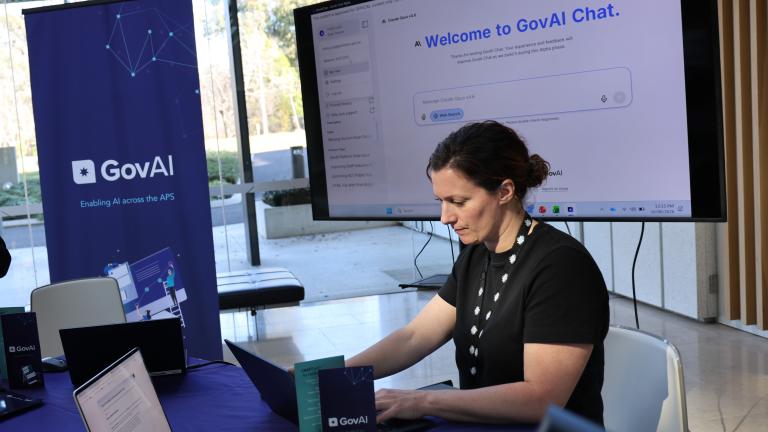
APS staff working on GovAI.
Image: Finance
The AI Plan for the Australian Public Service (APS AI Plan), launched in November 2025, positions artificial intelligence (AI) adoption as a service-wide reform. The plan aims to improve service delivery, policy outcomes, efficiency and productivity by supporting the safe and responsible use of AI across government.
The plan recognises that effective AI adoption depends on more than technology. Public servants need training, guidance, appropriate tools and leadership support to use AI safely and effectively. As such, the plan is designed to adapt as AI develops, recognising that generative AI is becoming embedded in digital infrastructure, enterprise tools and everyday services.
The APS AI Plan 2025 brings this work together through 3 mutually reinforcing pillars – Trust, People, Tools.
This approach treats AI as a whole-of-service capability, supported by strong governance, evidence, leadership, consultation and shared learning.
The 2025 – 26 reporting period marked a shift from establishing foundations to coordinated implementation. Agencies are testing and applying AI use cases, while whole-of-service work focuses on scaling approved tools, embedding responsible AI practices and addressing common barriers to adoption.
Key developments to 30 June 2026 included:
- release and implementation of the AI Plan for the APS 2025
- continued development of Government AI
- April 2026 alpha release of GovAI Chat
- appointment of Chief AI Officers across agencies
- strengthened responsible AI policy, including new AI impact assessment requirements
- APS consultation to create GovAI Exchange
- 37 onshore AI models available through the Model Brokerage Service
- new and updated procurement and information-handling guidance
- updated the AI technical standard for the secure and governed use of agentic AI
- common resources to reduce duplication and share good practice.
AI adoption is moving beyond isolated use cases, but coordinated implementation remains at an early stage. The APS is building the conditions needed to adopt AI responsibly and at scale. This includes common platforms and tools, workforce capability and confidence, clear governance and assurance, data readiness, implementation support, evidence of what works and measurable benefits.
Central coordination and shared platforms
Central coordination provides a common foundation for security, assurance approaches, information handling, procurement, capability development and shared learning. Agencies remain accountable for local implementation. This approach can reduce duplication and support more consistent approaches to risk.
The AI Delivery and Enablement function within Finance supports agencies to identify high-impact opportunities, share implementation lessons and apply a ‘prove once, reuse where appropriate’ approach. In 2025–26, its work included:
- supporting Chief AI Officers in agencies
- helping agencies test and validate AI patterns before wider deployment
- building evidence about implementation
- identifying policy, legal, procurement, privacy, security, data and workforce barriers.
GovAI, a secure, whole-of-APS AI platform, moved from concept to operation by designing and launching AI products across the service. By providing shared AI infrastructure and capability, GovAI enables agencies to adopt AI safely and responsibly. It does so while reducing duplication, accelerating innovation and building the digital skills the APS needs for the future. In 2025–26, GovAI delivered a generative AI chat app, designed an information sharing platform, managed a sandbox environment, and provided access to assessed AI models.
In April 2026, GovAI launched a 9-week alpha trial for GovAI Chat, a secure generative AI chat app for APS staff. More than 1,700 participants from 34 agencies took part, with 86% indicating they would like to continue using the app and 79% rating the app’s accuracy as good or excellent. Participants used GovAI Chat to ask questions, draft, summarise and analyse within a government-managed environment.
To design and build the GovAI Exchange prototype, GovAI completed extensive consultation and codesign with more than 300 APS staff from 53 agencies. GovAI Exchange aims to reduce agencies independently solving the same AI adoption challenges by providing reusable, government-tested resources. It also provides the opportunity to help agencies build on what others have already proven rather than starting from scratch.
The GovAI Hosting sandbox provided 14 agencies (19 business area customers) access to a secure, shared cloud environment to develop and deploy AI applications aligned to government security and sovereignty requirements. Agencies are building more than 28 documented use cases at proof-of-concept and pilot stage, including AI-assisted law interpretation, semantic search, and risk foresight applications. The sandbox reduces duplication of infrastructure procurement while enabling agencies to retain responsibility for their own deployments.
The Model Brokerage Service gave 10 agencies access to 37 onshore AI models and 23 global AI models. The service centrally manages access to assessed AI models, removing the need for agencies to establish separate commercial and technical arrangements. Agencies are using the services to support use cases spanning law interpretation, search capabilities, and regulatory analysis.
The policy for the responsible use of AI in government, combined with the AI impact assessment tool and accompanying AI technical standard, helps agencies adopt AI consistently and manage risks across its lifecycle. This framework continues to evolve alongside advances in the technology, including through the recently released Agentic AI Addendum to the AI Technical Standard for Australian Government.
Building capability for an AI-enabled workforce
Artificial intelligence (AI) readiness depends on skills, confidence, leadership, consultation and work design, not just access to technology. The People pillar of the AI Plan for the APS 2025 supports staff through change while building capability across the service.
The Australian Public Service Commission has a lead role in implementing the APS AI Plan, alongside Finance and the Digital Transformation Agency. The aim is to translate its strategic blueprint into practical capability uplift. Governance, accountability and decision-making are key learning outcomes.
The updated policy for the responsible use of AI in government established mandatory training expectations for all APS employees to ensure responsible and ethical AI use. The Digital Transformation Agency’s AI Fundamentals training is supported and facilitated through APSLearn. It complements GovAI’s learning resources.
Programs support staff to use generative AI responsibly in everyday work. They also help Senior Executive Service leaders guide adoption, build a safe culture and lead organisational change. More than 100,000 APS employees have completed foundational AI training. More than 13,000 have registered for the Australian Public Service Commission’s AI-related practical webinar series. This is establishing a baseline of AI capability across the service
APS Digital, Data and Cyber Workforce Plan – Horizon 1
The APS Data, Digital and Cyber Workforce Plan 2025–30 provides a coordinated, cross-agency approach to building the capabilities needed to deliver government priorities. Developed by the Australian Public Service Commission (APSC) and Digital Transformation Agency (DTA), the plan sets out a 5-year roadmap. Delivery is sequenced across 3 implementation horizons:
- Horizon 1 focuses on strengthening foundations
- Horizon 2 focuses on initiatives with greatest impact on outcomes
- Horizon 3 focuses on longer term, systemic reforms.
The plan addresses common workforce challenges across 4 action areas, attracting talent, developing capability, deploying specialists and improving workforce planning. By working collectively, agencies can share tools, programs and insights, leverage investment and build capability at scale. This supports a capable, sustainable and future-ready APS workforce.
In 2025–26, APSC and DTA focused on Horizon 1. Key achievements included:
- published the 2025 Digital Workforce Data Insights Report, strengthening the evidence base for workforce planning and decision-making
- delivered and expanded the Senior Responsible Officer Digital Governance Program, strengthening digital leadership and governance capability
- developed and published the Digital and Cyber Employee Value Proposition, supporting the attraction and retention of critical digital and cyber talent
- delivered the Executive Level 2 and Senior Executive Service (SES) Data Capability Uplift Initiative, strengthening data literacy and leadership capability among senior officials
- completed the APS Digital and Cyber Remuneration Benchmarking Report, providing insights to inform workforce and remuneration strategies
- developed and implemented SES Accountabilities for Data, strengthening leadership accountability and transitioning the initiative into ongoing delivery.
Horizon 1 has established momentum towards a workforce with the capabilities needed to support the government's data and digital priorities. The plan supports the Data and Digital Government Strategy and the 2023–2030 Australian Cyber Security Strategy. These strategies aim to deliver simple, secure and connected public services for all people and businesses and make Australia a world leader in cyber security by 2030.
The plan provides a unified approach to attracting, developing and retaining data, digital and cyber talent across the APS.
Digital Governance Program for Senior Responsible Officials
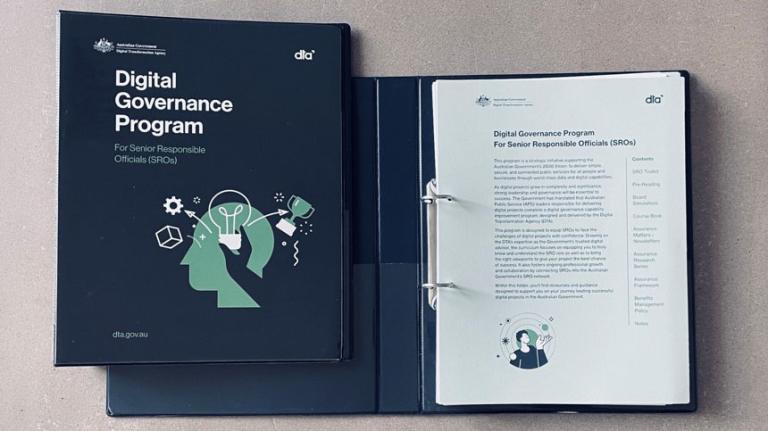
Digital Governance Program for Senior Responsible Officials learning material.
Image: Digital Transformation Agency
The Digital Governance Program strengthens the capabilities of Senior Responsible Officials (SRO) who lead major digital and information, communication and technology-enabled projects across the APS. It was designed and delivered by the Digital Transformation Agency (DTA).
The program, developed and launched in 2025, is now delivered on a regular basis. As of 30 June 2026, more than 100 executive leaders had completed it, increasing to more than 120 by July 2026. Participant feedback has continued to be strongly positive, with 100% satisfaction across participating cohorts.
Key to the Digital Governance Program is addressing a critical risk for government. Even well-funded and technically advanced digital investments can fail without capable leadership and governance that provide the right structure, capability, culture and flow of information. Rather than responding after projects fail, the program strengthens governance capability featuring a curated curriculum of topics and governance board simulations.
The Digital Governance Program directly supports senior executives overseeing more than 100 strategically important digital projects valued at $9.6 billion across 43 Commonwealth agencies. It was developed in partnership with several government agencies to reflect different delivery environments, organisational contexts and governance challenges faced by digital projects.
Participants focus on leadership topics and engage in simulations that follow a complex digital initiative through its full lifecycle, from initiation to delivery and closure. A practical toolkit of concepts and resources help participants make real-time governance decisions and understand their broader effects on business risk, delivery confidence, supplier performance and public trust. The program is also building a trusted cross-government SRO network. This gives alumni opportunities to develop peer connections and professional relationships that continue beyond the program.
The DTA identified the need to strengthen SRO capability through its digital investment assurance oversight. It then proposed the program as a reform initiative for government consideration. The importance of strong leadership in successful digital delivery is well understood. Despite this, SROs can be appointed to major Australian Government digital projects without specialist training or previous experience in complex digital delivery.
Starting at the 2024–25 Budget, the government mandated the Digital Governance Program for APS leaders appointed as SROs with accountability for successfully delivering the government’s future digital projects.
See also in this report
Protecting the nation and the region, Protecting Australia's biosecurity and export reputation, State of Service Report 2026.
Serving the Community, CLIKChat improves policy navigation and service delivery for veterans, State of Service Report 2026.
Find out more
Australian Government (2025) AI Plan for the Australian Public Service 2025, digital.gov.au, accessed 11 August 2026.
Australian Public Service Academy (2026) AI in government fundamentals, APS Academy website, accessed 11 August 2026.
Data and Digital Government Strategy (n.d.) Workforce plan, Data and Digital Government Strategy website, accessed 11 August 2026.
Data and Digital Government Strategy (n.d.) Digital Workforce Insights report, Data and Digital Government Strategy website, accessed 11 August 2026.
Digital Transformation Agency (2025) Policy for the responsible use of AI in government, digital.gov.au website, accessed 13 August 2026.
Digital Transformation Agency (2025) AI impact assessment tool, digital.gov.au website, accessed 13 August 2026.
Digital Transformation Agency (2025) Technical standard for government’s use of AI, digital.gov.au website, accessed 13 August 2026.
Digital Transformation Agency (2026) Agentic AI addendum to the AI technical standard, digital.gov.au website, accessed 13 August 2026.
Digital Transformation Agency (2025) Guidance on AI procurement in government, BuyICT website, accessed 13 August 2026.
Digital Transformation Agency (2026) Digital Governance Program Prospectus, digital.gov.au website, accessed 11 August 2026.
Digital Transformation Agency (2025) Registrations open for our Digital Governance Program, DTA website, accessed 11 August 2026.
Finance (2025) Introducing the APS AI Plan, Finance website, accessed 11 August 2026.
GovAI (2025) GovAI, GovAI website, accessed 11 August 2026.