



Operating context
Environment
The Australian Public Service exists to serve Australians. Whether it is delivering services, responding to emergencies, supporting government decisions or helping shape the country’s future, people rely on the APS every day.
The environment in which the public service operates is changing. Expectations are rising, problems are becoming more complex, and the pace of change continues to accelerate. At the same time, agencies are asked to do more with finite resources while responding to rapid advances in technology and changing workforce expectations.
These pressures shape how the Commission supports agencies to build integrity, strengthen leadership and develop a skilled workforce that is ready for the future. In recent years there has been a focus on reform. However, the focus has shifted from implementing change to fostering a culture of continuous improvement. This requires leaders who are prepared to learn, adapt and strengthen the APS over time.
Australians deserve government institutions that are open, accountable and able to explain the decisions they make. Trust depends on what decisions are made, and how they are made. The Commission continues to remain focused on strengthening leadership, ethical decision-making and fostering workplace cultures that earn and maintain public confidence. The outcome is a trusted APS that acts in the public interest and maintains the confidence of government, Parliament and the Australian community.
Government needs a public service that can respond to today’s priorities while preparing for tomorrow’s challenges. This requires a public service workforce that can adapt, learn and apply new skills as the environment changes. Attracting and retaining people with the right skills remains an ongoing challenge across the APS. Employment arrangements and workforce expectations continue to shape how agencies attract, support and retain their people. The Commission works with agencies to strengthen workforce planning, support the development of new skills across the APS and build a pipeline of leaders ready for the challenges ahead. Our goal is an APS that remains capable, adaptable and prepared for an increasingly complex future.
Australian communities are diverse, and people’s experiences of government are not the same. Effective decision-making depends on understanding the needs and experiences of our communities. The Commission continues to focus on mobility, talent development, career pathways and a diverse public service that broadens experience and strengthens connections within and between communities across Australia. We will continue to help build a public service that is connected to the people and communities it serves and equipped to make informed decisions in the interest of all Australians.
Technology is changing the way the public service does its work. We must move beyond simply adopting new technology and embracing using it well to improve productivity and empower people to focus on work that requires judgement, lived experience and human connection. The expectations for information governance, responsible data use and cybersecurity continue to grow. In this environment, the Commission is focused on helping agencies build the skills and judgement needed to use new technologies effectively, and ethically, to adapt to changing ways of working, and make the most of the opportunities new technology creates. The outcome is a modern APS that uses technology to create capacity, improve decision-making and deliver better outcomes for Australians.
Good public institutions are built over time. They rely on people who are committed to serving others, making sound decisions and leaving the system stronger than they found it. That stewardship sits at the heart of the APS and continues to guide the Commission’s work.
Capability
Workforce
Our people are our greatest asset. We are committed to maintaining a diverse, capable, inclusive and professional workforce, supported by enhanced tools and processes that enable our staff to perform at their best.
The Commission will focus on maturing the capability of our workforce to ensure we have the right skills at the right time and in the right place, now and into the future. We are developing a workforce plan that will support the Commission to adapt to changing needs, technology and policy priorities.
Strengthening the Commission’s capability is critical to delivering on our purpose. Investing in our people and systems enables us to lead by example, uphold public sector values, and build the flexibility and expertise needed to meet evolving government and community expectations.
To ensure we can do our job well, we are focused on reflecting the diversity of the Australian community in our workforce and creating a safe, respectful and inclusive workplace. Our policies and guidance will continue to shape and support this work over the coming years.
We will continue to invest in our people through a range of learning and development opportunities, preparing our workforce to meet future demands. At the same time, we are prioritising improvements to our assets, technology, systems, tools and processes so our people can do their jobs well.
In a highly competitive labour market, we continue to adapt our attraction, recruitment and workforce planning approaches to secure the skills and expertise required.
Supporting the wellbeing of our people is equally important to us. We are committed to providing access to contemporary wellbeing supports and reasonable adjustments to ensure everyone can thrive at work. Our focus on both physical and psychological health reinforces our goal to be an employer of choice and maintain a psychologically safe and pro-integrity culture throughout our workplace.
Our National Property Strategy ensures our properties and their amenities enable our staff, some of whom are geographically dispersed across the country, to collaborate and connect in a way that is efficient and aligns with the work we undertake.
Strategic Commissioning Framework
As required by the APS Strategic Commissioning Framework, for 2026–27 the Commission has identified the following job families as core work:
- Accounting and Finance
- Administration
- Communications and Marketing
- Compliance and regulation
- Data and research
- Human Resources
- ICT and digital solutions
- Information and knowledge management
- Intelligence
- Legal and parliamentary
- Monitoring and audit
- Policy
- Portfolio Program and Project Management
- Senior Executive
- Service delivery
In 2026–27, the Commission will further embed the APS Strategic Commissioning Framework by reviewing human resources and procurement policies and forms to ensure strategic commissioning principles are consistently applied across workforce and procurement decisions.
The Commission will also further strengthen internal capability and knowledge retention by prioritising APS employees and, where appropriate, partnering with other APS agencies where appropriate to deliver core work.
Technology
Our ambition is to use modern technology and contemporary digital services to support the Commission to be a valued, credible and trusted partner to the APS.
Recent advancements in areas such as data analytics and artificial intelligence represent significant opportunities to improve how we deliver services, support decision-making and enhance workforce productivity. Our technology strategy responds to the changing expectations for digital service delivery, increasing cyber security threats, growing demand for data-driven insights and the need to support a modern and flexible workforce. To make the most of these opportunities, we are focused on strengthening our technology foundations and updating our technology strategy in 2026-27.
Our current approach to building ICT capability and positioning the Commission to respond to future business needs and emerging technologies is guided by the following six core principles. These help us respond effectively to current needs and future opportunities.
Table 1: Six core principles of our technology strategy
| Core principles | How we will apply the principles |
|---|---|
| User-centred | We prioritise the needs and experience of our users – the Commission’s staff and clients – to deliver digital services that are intuitive, accessible and responsive. |
| Reliable | We ensure our technology is consistently available, performs as agreed, is well supported and recovers quickly from disruptions. |
| Secure | We protect the Commission’s technology, digital and data assets from unauthorised access, data breaches and other cyber security threats. |
| Sustainable | We prioritise technology investments that improve the long-term viability and cost-effectiveness of our technology services. |
| Innovative | We facilitate the exploration and use of new technologies that have the potential to improve the Commission’s operations and services. |
| Integrated | We enable the Commission to break down data silos and to combine, analyse and leverage our extensive data assets. |
Our strategy centres on two technology priorities; to provide a 'Modern workplace' and to enable 'Modern services'. Critical to the successful implementation of the technology strategy are our 5 core themes: technology, digital, data, cyber security and AI.
Figure 1: Our technology priorities are underpinned by 5 implementation themes
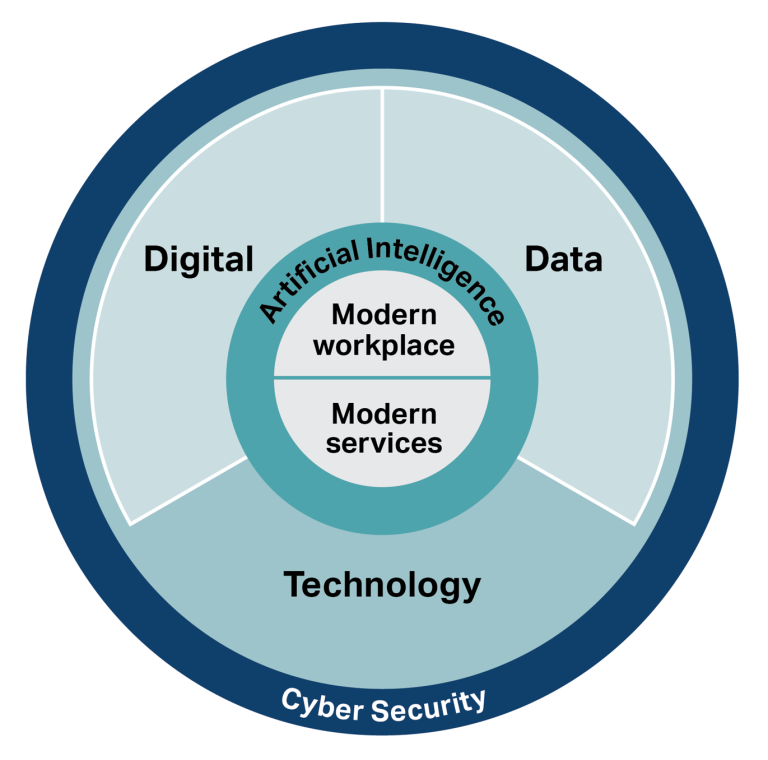
Our technology strategy aligns with broader Australian Government priorities for secure, user-centred and digitally enabled public services. We will continue to strengthen cyber security capabilities, adopt contemporary approaches to information and data management, and ensure the responsible use of AI through appropriate governance and oversight. We will also leverage whole-of-government platforms and collaborative opportunities where appropriate and meets our business needs to improve ICT capability, reduce duplication and maximise value from technology investments.
These initiatives will help ensure the Commission’s technology capability evolves and continues to support us to achieve our purpose and key activities.
Risk management
Governance arrangements
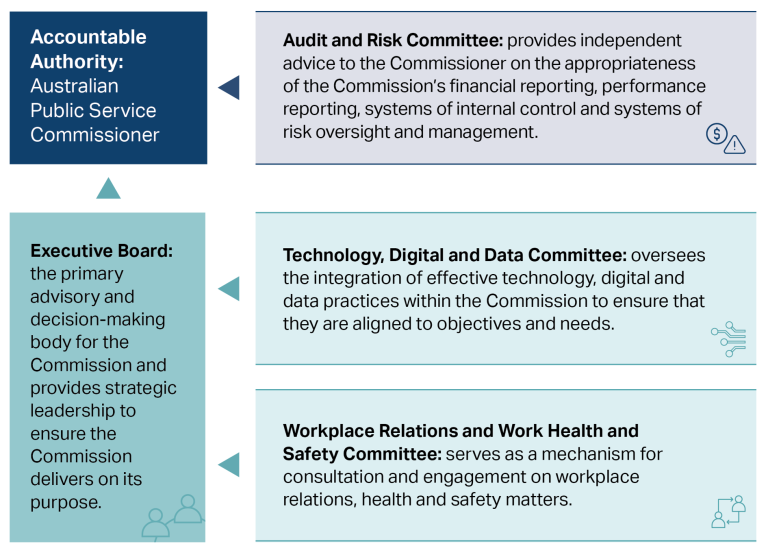
The Commission’s committee structure works to promote good governance and supports our accountable authority to set the Commission’s strategic direction, priorities and accountabilities.
Our governance arrangements promote decision-making that is evidence-based, ethical, efficient and effective to meet compliance obligations and support our people to achieve our purpose and deliver on priorities.
We are currently reviewing our governance arrangements to ensure they continue to meet the Commission’s needs and support effective decision-making. We are focused on strengthening governance capability, streamlining processes, and identifying opportunities to better use technology to improve the value of our governance forums.
Figure 2: Our governance committees
Risk oversight and management
Effective risk management is essential to achieving our purpose, improving our performance and meeting the expectations of the Australian Government and the public. By proactively identifying and managing risks, we can better respond to challenges that may affect the delivery of our work while also positioning ourselves to make the most of opportunities for innovation and reform.
The Commission’s Risk Management Policy and Framework 2026–28 establishes our approach to the management of risk and embeds risk management in the Commission’s operational, governance and decision-making processes. Our Policy and Framework is consistent with the requirements outlined in the Public Governance, Performance and Accountability Act 2013 and the Commonwealth Risk Management Policy.
The Commission will continue to embed and strengthen the Commission’s risk management framework to support consistent, informed decision-making and effective management of risk impacting on the delivery of our work. The focus in the coming year will be to uplift risk capability across the Commission to strengthen our organisational resilience and improve delivery of strategic outcomes.
The Commission’s risk appetite and tolerance statements establish our parameters for acceptable risk-taking within certain categories of risk, including our ability to meet our legislative obligations or maintain effective systems to support our operations. We adopt a balanced level of risk to pursue opportunities, innovation and better outcomes, supported by evidence-based decision making and continuous learning. However, we take a more prudent approach to risk-taking when it may adversely affect the wellbeing of our people, ethical standards, reputation, or compliance with statutory requirements. Risks outside of these parameters are escalated to ensure appropriate oversight and monitoring.
Our strategic risks
Our strategic risks are the key risks that affect our strategic intent and impact on the achievement of our purposes, objectives and key activities.
The Executive Board reviews the Commission’s strategic risks each year, considering changes to our operating environment, risk profile and emerging risks.
Table 2: Strategic risks, owners and mitigations
| The Commission fails to maintain the foresight and adaptability required to effectively steward the Australian Public Service in a changing operating environment. | |
|---|---|
| Owner | First Assistant Commissioner, Integrity & Enabling Services |
| Mitigation | Governance and planning mechanisms support ongoing environmental scanning, emerging risk identification, business continuity preparedness and strategic response planning. |
| The Commission is unable to maintain the frameworks, systems and influence needed to uphold high standards of integrity and conduct across the Australian Public Service. | |
|---|---|
| Owner | First Assistant Commissioner, Integrity & Enabling Services |
| Mitigation | Maintenance of APS integrity frameworks, delivery of leadership integrity training and assessment of the effectiveness of integrity-related activities support strong integrity standards across the Australian Public Service. |
| The Commission is unable to align Australian Public Service workforce conditions with workforce expectations and labour market trends to attract and retain the talent needed for a future-ready Australian Public Service. | |
|---|---|
| Owner | First Assistant Commissioner, Workforce, Tribunals and Inclusion Support: Chief Negotiator, APS Bargaining |
| Mitigation | Workforce policy settings, bargaining arrangements, diversity initiatives and workforce insights support attraction, retention and workforce competitiveness across the Australian Public Service. |
| The Commission is unable to develop and implement effective initiatives, programs and training to build the capability and leadership of the Australian Public Service. | |
|---|---|
| Owner | Deputy Commissioner, APS Academy & Capability |
| Mitigation | APS-wide leadership and capability frameworks, targeted development programs and ongoing performance monitoring support workforce capability uplift across the Australian Public Service. |
Cooperation
The Commission's work is underpinned by collaboration. We work with Ministers, APS agencies, government entities, employee representatives, strategic partners, academic institutions and international counterparts to strengthen the capability, integrity and effectiveness of the public service.
Many of these relationships span multiple areas of our work and make a significant contribution to achieving the Commission’s purpose. Together, they help us identify emerging issues, shape policy, build capability, coordinate implementation and support continuous improvement across the APS.
Promoting and upholding high standards of integrity
Integrity is strengthened through collaboration across government. We work with APS agencies, Ministers, parliamentary committees, employees, and employee representatives to uphold the APS Values, Code of Conduct and Employment Principles, and strengthen integrity frameworks and support accountability across the APS.
Through governance forums including the APS Consultative Committee, Integrity Agencies Group, Secretaries Board and Chief Operating Officer (COO) Committee, we identify emerging issues, develop guidance and promote consistent approaches to promoting and upholding high standards of integrity and conduct across the service.
The Commission has established partnerships with other integrity agencies, key policy agencies and international counterparts such as the National Anti-Corruption Commission, Commonwealth Ombudsman, and the Department of Finance, and the Organisation for Economic Co-operation and Development (OECD) to strengthen public trust, improve integrity frameworks and ensure we continue to learn from leading practice.
Supporting high-quality workforce management
A capable workforce depends on a coordinated approach across government. We work with APS agencies to strengthen APS-wide workforce planning, recruitment, mobility and implementation of employment policies across the APS.
We leverage APS governance forums, interdepartmental committees and cross-government working groups to coordinate implementation of workforce policy, share expertise and respond to emerging priorities. This includes forums such as the COO Committee, Capability and Workforce Committee, Secretaries Digital and Data Committee and participation in interdepartmental committees supporting whole-of government priorities.
We also partner with agencies including the Department of Finance, Digital Transformation Agency, Department of Home Affairs, Department of Defence and the Australian Bureau of Statistics, together with state and territory governments, universities and industry partners. These partnerships provide the evidence, expertise and workforce insights needed to develop practical policy and prepare the APS for future workforce challenges.
We exchange knowledge, experience and insights with foreign government partners in our region and multilateral institutions on public sector reform, workforce management, leadership and career management. We work closely with our counterpart agencies in Fiji, Indonesia, Kiribati, Naoero, New Zealand, Papua New Guinea, Samoa, the Solomon Islands, Tonga and Vanuatu. We also engage with counterparts through ASEAN. We represent Australia at the OECD Public Governance Committee and provide technical assistance to Indonesia on its OECD accession plans.
Building leadership and APS capability
Building capability requires strong partnerships across the APS and beyond. We work with APS agencies, senior leaders and strategic partners to identify capability needs, develop leadership pathways and strengthen the skills needed to deliver for government and the Australian community.
Through the Secretaries Board, COO Committee, Capability and Workforce Committee, APS Learning Board, APS Academy Faculty, Heads of Professions, and Secretaries Talent Council and Deputy Secretaries Talent Council, we set capability priorities, guide learning and support continuous improvement across the APS.
The APS Academy brings together practitioners, subject matter experts and partner organisations to co-design and deliver learning that reflects the experience of the APS. We partner with organisations such as the Australia and New Zealand School of Government, the Sir Roland Wilson Foundation and the Institute of Public Administration Australia. We share learning and expertise beyond the APS and work with universities, research institutions and the OECD to bring together research, practical experience and international perspectives to ensure leadership development remains contemporary, relevant and effective.
Through Communities of Practice, APS professions and specialist capability hubs, these partnerships strengthen leadership, develop specialist expertise and prepare the APS for future challenges.
Supporting key government institutions and functions
Through the provision of employees, capability and secretariat services, the Commission supports a range of government institutions, statutory office holders and committees that contribute to the effective operation of government.
Remuneration tribunals
The remuneration tribunals perform an important role in determining, reporting and advising on allowances and entitlements for office holders, including parliamentarians, judicial and non-judicial court and tribunal holders and members of the Australian Defence Force.
Merit Protection Commissioner
The Merit Protection Commissioner supports agencies, departments and employees to meet their responsibilities, including through offering a system of review on a range of actions, decisions and promotions, complaints investigation and assistance with recruitment and selection processes.
Parliamentary Service Commissioner
The principal functions of the Parliamentary Service Commissioner are to advise the Presiding Officers of the Parliament on the management of policies and practices of the Parliamentary Service and to conduct any inquiries about the Parliamentary Service at the request of the Presiding Officers.
Parliamentary Service Merit Protection Commissioner
The Parliamentary Service Merit Protection Commissioner reviews parliamentary workplace decisions to make sure they are fair and correct through adjudicating disagreements about workplace decisions, inquiring into alleged misconduct in the workplace, reviewing agency decisions to ensure agencies have followed the appropriate processes and directions, and ensuring recruitment and promotion decisions are based on merit.
Whole-of-Government Committees
The Commission provides secretariat support to the COO Committee, Collaboration Circle (a sub-committee of the COO Committee) and the Capability and Workforce Committee.
Subsidiaries
The Commission does not have any subsidiaries.