



Diversity for improved delivery

Diversity is a critical organisational capability. A workforce that represents the people it serves strengthens public trust, confidence in government institutions and improves policy and service delivery.
Different perspectives, cultural backgrounds and lived experience broaden the range of insights decision-makers can draw on, helping to identify blind spots, challenge assumptions and anticipate unintended consequences. Policy and service design success depends on understanding how decisions will affect people with different circumstances, experiences and needs.
These efforts signal a shift from seeing diversity as a workforce representation issue to being a dimension of organisational capability. An Australian Public Service (APS) that can draw on the widest possible range of talent and perspectives improves the quality of policy advice, service delivery and outcomes for Australians.
Jobs and Skills Australia First Nations Workforce Strategy
Jobs and Skills Australia (JSA) engages, advises and assists the Australian Government and industry stakeholders on current, emerging and future skills and the workforce needs of the country’s economy.
Understanding the diversity and composition of the Australian labour market is essential to informed, decision-ready analyses and insights that are more accurate, equitable and impactful. A workforce that reflects that diversity and a workplace culture that supports it are core enablers to JSA’s work.
Ensuring that Aboriginal and Torres Strait Islander peoples are acknowledged, heard and empowered is a key priority. In December 2025, JSA launched its inaugural First Nations Workforce Strategy. This is a 3-year pathway with clear targets and success measures, accountability and regular reporting. The pathway is designed to sustain transparency and momentum with the aim of increasing First Nations representation to 5% or more by 2028. Actions focus on cultural inclusion, safety, leadership accountability, talent attraction, retention, and career development and growth.
The strategy was developed with input from JSA’s Murtu Yayngiliyn (Walking Together) team, colleagues from the Department of Employment and Workplace Relations (DEWR), and the Australian Public Service Commission. JSA’s approach was also guided by the Australian Institute for Aboriginal and Torres Strait Islander Studies’ consultation principles.
Since its launch, JSA has partnered with First Nations stakeholders to co-design the First Nations Exit Yarn Guidelines and the forthcoming Statement of Commitment to First Nations Peoples. Stakeholders include the:
- Murtu Yayngiliyn team
- DEWR Diversity and Inclusion (First Nations) team
- Murtu Yayngiliyn Cultural Advisory Panel, which represents First Nations peak bodies across Australia.
The strategy helps JSA be an employer of choice for First Nations peoples. It also aligns with Priority Reform Three of the National Agreement on Closing the Gap to transform:
- how government organisations work with Indigenous communities
- DEWR’s reconciliation commitments
- the Australian Government’s approach to improving employment outcomes for First Nations peoples.
First nations Water Branch creating sense of community in dispersed team
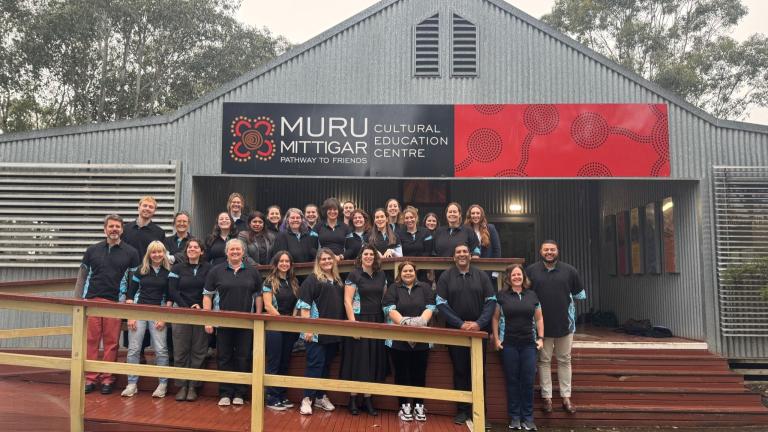
The First Nations Water Branch, Muru Mittigar Cultural Education Centre – building connection, cultural capability and community across a nationally dispersed team.
Image: Climate Change, Energy, the Environment, and Water
The First Nations Water Branch supports staff around Australia to share knowledge and strengthen cultural capability. Staff do so while delivering water priorities in partnership with First Nations people and communities.
Work includes practical approaches that help staff stay connected, support wellbeing, and build respectful ways of working. Practical approaches include:
- a monthly newsletter shares work updates, cultural insights, staff achievements, and personal milestones
- a branch book club creates space to explore First Nations authors, perspectives, histories and contemporary experiences
- cultural competency sessions support staff to learn about First Nations cultures, histories, protocols and contemporary issues
- peer-to-peer mentoring and APS-level peer spaces help staff share knowledge, seek advice and learn from each other outside formal reporting lines
- buddying for new starters gives staff a point of contact to understand the branch, its programs, relationships and ways of working
- Staff travelling on Country are supported before, during and after engagement, including through check-ins, shared responsibilities and time to recover
- responsibility for cultural learning sits across the whole branch and First Nations staff can share their cultural knowledge where they choose to do so
- flexible and family-centred ways of working help staff manage work alongside family, community and cultural responsibilities
- regular branch connection sessions help nationally dispersed staff understand each other’s work and how it contributes to the branch’s broader purpose.
Together, these practices help staff share the load, recognise effort, prioritise wellbeing and build the relationships needed to deliver better outcomes for First Nations people, communities and Country.
Elevating lived experience to improve services
Services Australia delivers payments and services that most Australians will access at some point in their lives. This includes Medicare, income support, the age pension, as well as family, disability and carer payments. Drawing on the lived experiences of people who use these services helps the agency better serve the community. This is particularly the case for those experiencing vulnerability, disadvantage and barriers to support.
In 2025, Services Australia established the Lived Experience Reference Group to progress and strengthen its approach to human-centred service design. This is a dedicated forum for engagement, bringing community perspectives directly into agency discussions on service delivery, design and improvement.
Participants include people with direct experience of Services Australia’s payments and services. It also includes representatives from peak bodies and advocacy organisations to support members and enable inclusive participation. A multidisciplinary team, led by Services Australia’s Research and Design Branch, supports the Reference Group. A social worker helps maintain psychological safety throughout discussions.
Sessions focus on key topics identified by participants or by agency business areas seeking input to inform service design, policy or service delivery improvements. Senior executive leaders provide strategic context and personal reflections. Meaningful discussion and practical insights are supported by participants receiving relevant background material in advance. Key themes are captured, synthesised and provided to relevant business areas to inform service improvements and future work.
The Lived Experience Reference Group generates insights that quantitative or operational data alone cannot provide, making service design and delivery more responsive to people’s specific needs. Reference group participants have reported positive personal impacts, including feeling heard and feeling more confident that their experiences can contribute to meaningful change.
A dedicated lived experience group makes Services Australia better equipped to hear from the community and better able to apply those insights to service improvements. It also reflects the agency’s commitment to embedding lessons from the Royal Commission into the Robodebt Scheme, including practical mechanisms that elevate lived experience in decision-making.
Examples of changes that have been influenced or suggested by the reference group include:
- support for frontline staff to enhance their skills in empathy
- improved communication around the agency’s use of artificial intelligence
- investment in more accessible products, for example Easy Read documents
- more human-centred processes that put people first, ranging from notifying the death of a loved one, to reporting changes in circumstances
- placement of self-service terminals in service centres to better meet customer needs.
See also in this report
A capable and future ready APS, APS Culturally and Linguistically Diverse Sponsorship Program Pilot, State of the Service Report 2026.
Agency Benchmarking, Employment of People with Disability, State of Service Report 2026.
Agency Benchmarking, First Nations Employment, State of Service Report 2026.
Agency Benchmarking, Senior Executive Service Cultural and Linguistic Diversity, State of Service Report 2026.
Working in the APS, A culturally safe and socially cohesive APS, State of the Service Report 2026.
Working in the APS, Improving accessibility and disability inclusive workplaces through the Disability Royal Commission Taskforce, State of the Service Report 2026.
Find out more
Department of Climate Change, Energy, the Environment and Water (2025) Working with First Nations, DCCEEW website, accessed 22 September 2026.
Department of Climate Change, Energy, the Environment and Water (2026) First Nations water policy, DCCEEW website, accessed 22 September 2026.
Department of Climate Change, Energy, the Environment and Water (2026) Committee on Aboriginal and Torres Strait Islander Water Interests, DCCEEW website, accessed 22 September 2026.
Department of Climate Change, Energy, the Environment and Water (2026) Murray–Darling Basin Aboriginal Water Entitlements Program, DCCEEW website, accessed 22 September 2026.
Department of Climate Change, Energy, the Environment and Water (2026) Cultural Flows Planning for Cultural Economies Grants, DCCEEW website, accessed 22 September 2026.
Jobs and Skills Australia (2026) Work with us, Jobs and Skills website, accessed 22 September 2026.
Regional Development Australia (n.d.) Restoring flow: The push for water justice, RDA website, accessed 22 September 2026.