



Outcomes and emerging impacts from the first 2 years of the APS Reform Agenda
Summary
This report provides an early assessment of the APS Reform Agenda’s:
- Achievements to date: What have initiatives achieved and how are they contributing to Reform outcomes?
- Whole of Reform Agenda value: How are reform initiatives working together to benefit Australian communities and business?
Analysis is based on secondary data ( i.e., already existing data) collected by the APSC evaluation team.
Delivering for Australia in the 21st century
Australia faces complex challenges and disruptions
- Geo-political instability: Rapid changes to the post-war international order and Australia’s place in it
- Global economic challenges: Slowing economic growth, reduced economic dynamism, increased uncertainty and economic inequality
- Social and public policy issues: Increasingly complex, interconnected and unpredictable
- Demographic change: Ageing population; changed drivers of population growth; changing social composition
- Declining trust in government and public institutions, here and internationally
- Technological advancements and disruptions: Powerful social media platforms, generative AI, digital and data exploitation
- Social fragmentation and polarisation: Conflicts and divisions (domestic and global), growing inequality, social media amplification of division
Ensuring capability and trust in the public service is critical. Australians expect government and the public service to [1]:
- Enable a good standard of living, followed by improving wellbeing and delivering services and social infrastructure
- Prioritise community wellbeing in government decision-making: 8 in 10 feel this way
And they want:
- Ordinary citizens to have a greater say in setting policy priorities: 6 in 10 agree with this
- A public service with the in-house capability and skills to deliver social services: 83% say this is important
Navigating these challenges and meeting growing public expectation requires new skills, capabilities and ways of working
Key findings from the data
The APS Reform Agenda is the most comprehensive public sector reform of the past 40 years that involves:
- Enduring, whole-of-service transformation for a capable, trusted APS delivering for Australians
- Delivering tangible results across the service
- Steady, scalable change being embedded
Headline findings
| Delivery › Laying the foundations for enduring change |
|
| Achievements › Concrete, tangible results across the Pillars |
|
| Impacts › Early signs that APS Reform is benefiting the public |
|
Findings – detail
Reform Agenda commitments are being delivered
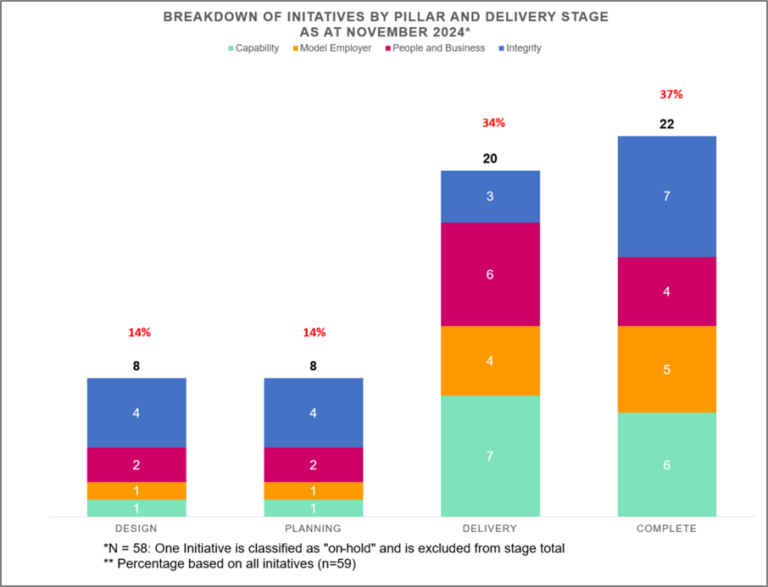
- Majority of APS Reform initiatives are complete or in delivery: 42 of 59 or 71%
- Almost all Stage 1 commitments are complete or in delivery (86%)
- Across each of the Pillars in this phase relatively consistent progress has been made in terms of completion, with three of four pillars halfway completed:
- Pillar 1 50%
- Pillar 2 36%
- Pillar 3 50%
- Pillar 4 55%
- For Phase 2, 4 of 15 initiatives (26%) are complete or in delivery.
The chart below shows the status of initiatives by pillar and Stage (as at November 2024).
- An engaged APS workforce to embed Reform Initiatives:
- 90% of APS employees endorsed acting with and championing integrity as top reform priority, followed by continuously improving capability and centring the public in service design (Hall and Partners, 2023)
- Almost 60,000 staff responded to the 2024 Commonwealth Integrity Survey
- 100% of in scope agencies reported on core work and targets for the Strategic Commissioning Framework
The Reform Agenda is embedding enduring, whole of service change
- Legislative foundations lock in key reforms, e.g.,
- Integrity - Stewardship as a value; NACC; PGPA Fraud anti-corruption provisions;>
- Capability - Capability Reviews; Long-term insights briefs;
- Driving whole-of-service transformation through compulsory initiatives: Half (49%) of Reform Agenda initiatives require all APS agencies to take action
- A delivery function to enable implementation, providing governance, reporting and engagement mechanisms to deliver across the service
Achievements and impacts
Pillar 1 – Integrity
Trust in government and public institutions is the protective glue for a cohesive, prosperous and democratic society and the foundation for effective and ethical service delivery to the community.
| Key Achievements |
|
Strengthening accountability and integrity
|
|
Championing stewardship – APS Values
|
|
Increasing transparency:
|
|
Embedding a pro-integrity culture
|
| Early Impacts |
|
Integrity issues are being addressed efficiently
Increased action taken on integrity issues:
Awareness (NACC Integrity survey)
An engaged public service committed to stewardship as a value
|
| Benefits to the public |
|
Public trust in services maintained over last 3 years
An APS of high trust and integrity means the services people receive, how they are treated, and how personal information is used are guided by clear standards of ethical integrity. An APS that acts as a steward means decisions are made on behalf of Australia and for the long-term national interest. |
Pillar 2 – Putting people and business at the centre of policy and services
Improving the ability of the APS to engage and partner across business, academia and the public produces value for the Australian community by leveraging a broader range of expertise to inform policy and services in an increasingly complex environment.
| Key Achievements |
|
Putting people and business at the centre:
|
|
Improving service delivery and experiences:
|
|
Partnering with communities and businesses:
|
| Early Impacts |
|
Accessible digital services through myGov
Services are meeting people’s needs: Trust in Australian public services survey 2024 shows that
Business and industry engagement to better understand operating contexts and inform policy design
Building capability for First Nations partnerships
|
| Public Benefit |
|
A proactively engaged APS understands the priorities of Australian people and businesses and delivers better quality services. Business insights inform policy and market engagement. Strong collaboration, engagement and partnership capabilities are essential to address issues complex problems. User and human centered design embedded in digital service delivery. Data sharing makes it easier for businesses and services to develop informed, relevant programs and services. |
Pillar 3 – A model employer
Australia requires a skilled and engaged APS that understands the needs of the public, and able to deliver excellent services and policies.
| Achievements |
|
Centralised bargaining made APS a more competitive employer
|
|
An engaged, motivated service working on behalf of Australians:
|
|
Ensuring APS reflects the community it serves:
|
|
Boosting First Nations employment
|
| Early Impacts |
|
The APS is increasingly becoming a great place to work
APS is improving on attracting the ‘best and brightest’:
Setting an example for all Australian employers around workplace gender equality
Improved First Nations representation:
85 SES identified as First Nations in 2024, up from 54 in 2003 (up from 1.7% of all SES in 2023 to 2.5% in 2024) |
| Benefits to the public |
|
Pillar 4 The capability to do its job well
By building a skilled and capable workforce, the APS affirms itself as a national asset, able to deliver policies and services for the Australian public, now and into the future.
| Achievements |
|
Quantifying use and cost of external labour – a critical knowledge gap
|
|
Returning core work to the public service
|
|
Capability uplift for the future:
3 new Professions: Evaluation, Complex Project Management and Procurement and Contract Management |
| Early Impacts |
|
APS capability is being strengthened by investing public monies back into the APS workforce
Building up capability for the future:
Collaborating across the Indo-Pacific region to address climate change APS Indo-Pacific Executive Development program fostered stronger connections with the Indo-Pacific. Program commenced on 2 November 2023 with 103 participants from 27 agencies, providing a rich diversity of perspectives shared throughout the 7-month learning journey |
| Benefits to the Public |
|
Reduced reliance on external labour hire and reinvesting back into the Public Service, supports in-house capability uplift, so policies and services are undertaken in a transparent and effective manner for the Australian public. As the work is done in-house, expertise and skills can be consistently leveraged to produce high-quality output. Australians have confidence in the capability of the public service in delivering essential services. |
* Note: Audit data reflects the portfolio structures as at 30 June 2022 and drawn from agencies finance and reporting systems. Neither the Department of Finance nor APSC undertook quality assurance of the data provided. As such, caution should be taken when analysing the Audit data, comparing the Audit data with broader APS-related data.
How reforms work together to achieve long-term change
Delivering for people, businesses and the community
The progress and achievements in strengthening integrity, building capability and attracting the best and brightest are all in service of meeting the diverse and evolving needs of the Australian community.
The four reform pillars work together to achieve outcomes for the public:
Integrity reforms: are strengthening trust in the public service to deliver for Australia. Trust is foundational to democracy and all the work of the APS. Indeed, to engage and partner with people and business, the APS must be trusted.
People and Business are at the centre: The APS needs to hear from the public about what matters and how to improve. Listening to people and business via partnerships and engagement provides the APS with data and insights to deliver better services.
The APS is a model employer: that values and benefits from Australia’s diversity, attracting and retaining the best and brightest. The APS must have the right people to be effective and capable.
The APS has the capability to do the job well: The APS is strengthening capability to meet Australia's current and future needs. It must continuously improve to meet the evolving needs of people and business in a way that maintains trust and integrity.
Interconnected reforms work together to embed whole of service transformation and ensure the APS:
- Delivers ethically on behalf of the public
- Is future ready
- Delivers for the long-term public benefit
Delivering for the long-term public interest
- Ensuring APS has in-house capability to deliver on core functions
- Investing in long-term capability of public institutions for the public benefit
- Reduced risks to integrity, expertise and public trust posed by excessive outsourcing
Ethical delivery:
- APS is trusted to deliver on behalf of Australians
- APS reflects and connects with the community it serves
Capable, future ready delivery
- The right skills and expertise needed for the future
- The right tools and systems
- Collaboration and innovation to solve complex challenges
Footnote
[1] Williams and Hammerle (2024), Purpose of Government Pulse - Centre for Policy Development